

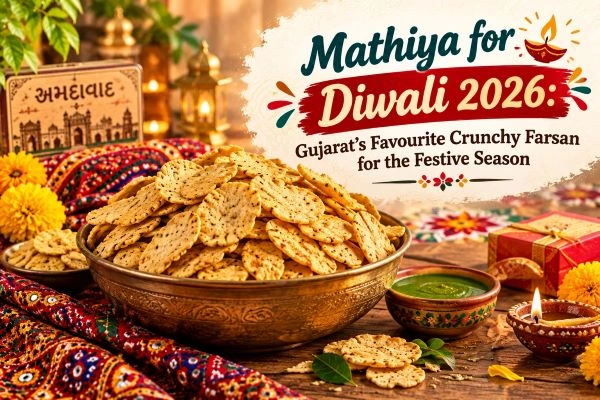
Diwali 2026 falls on Sunday, November 8, with the celebrations beginning at Dhanteras on November 6 and running through Bhai Dooj on November 10—five days during which Gujarati kitchens barely stop producing farsan for family, guests, and neighbors dropping by. Among all the snacks that come out during this stretch, mathiya holds a permanent, non-negotiable spot on the plate.
Mathiya is one of those snacks that manages to be both a daily-life staple and a festival essential at the same time. It’s eaten year-round with chai, but during Diwali specifically, it takes on a slightly more special role—made in larger batches, offered to guests first, and often gifted alongside other farsan in Diwali hampers. If your Diwali shopping list doesn’t have mathiya on it yet, here’s why it should, and which varieties are worth trying this year.
What Is Mathiya, Exactly?
Mathiya is a deep-fried Gujarati snack made from gram flour (besan) dough, seasoned with spices, and shaped into small, ridged, cylindrical pieces before frying until golden and crisp. The ridged shape isn’t just decorative—it increases the surface area, giving mathiya its signature crunch and helping it hold onto spice coatings better than smoother snacks.
What makes mathiya particularly popular during Diwali is its versatility. It’s mild enough to be eaten by itself in large quantities but also spiced enough in some variants to double as a flavor-forward snack for guests who want something with more kick than a plain ganthiya or khakhra.
Mathiya Varieties Worth Adding to Your Diwali 2026 Order
One of the reasons mathiya has stayed popular across generations is how well it adapts to different spice preferences within the same family — and this Diwali, that range is worth taking advantage of rather than sticking to just one type.
The Regular Mathiya is the classic starting point — mildly spiced, universally liked, and the version most households grew up eating with their evening chai. For a deeper, crunchier bite, the Fried Regular Mathiya takes the same base recipe further into the fryer, resulting in a firmer, more textured snack that holds up well over the full five days of Diwali guest visits.
For those who like their farsan with a bit more heat, the Green Chilli Mathiya brings a fresh, sharp spice that cuts through the richness of the fried besan, while the Fried Green Chilli Mathiya intensifies both the crunch and the heat for anyone who wants their Diwali snacking to come with a kick. If green chilli alone doesn’t cut it, the Double Chilli Mathiya goes a step further, layering in extra spice for guests who specifically ask for “something spicier” at every Diwali gathering — there’s always at least one.
The Red Chilli Mathiya offers a different kind of heat altogether — a smokier, more robust spiciness compared to the sharper green chilli versions, and a good option for balancing out a mixed farsan platter. Meanwhile, the Green Garlic Mathiya brings a distinctly aromatic, savoury edge that’s become a favourite among those who want their mathiya to taste a little different from the standard festive spread without straying too far from tradition.
For guests managing sugar intake or simply preferring a less sweet-adjacent snack, the Sugarfree Mathiya is a thoughtful addition to any Diwali order — proving that even a traditional festive namkeen can accommodate modern dietary preferences without losing its authentic character.
Why Mathiya Works So Well for Diwali Entertaining
Diwali in Gujarati households is essentially five days of open house — friends, extended family, and neighbours dropping in across Dhanteras, Choti Diwali, Lakshmi Puja, Govardhan Puja, and Bhai Dooj. Mathiya is practical for exactly this kind of continuous entertaining: it’s quick to serve, doesn’t need any preparation, has a long shelf life compared to fresh sweets, and comes in enough spice variations that you can offer something different to each guest without extra effort.
It’s also a reliable choice for Diwali gift boxes. Pairing a few mathiya varieties — say, regular, green chilli, and green garlic — into a single hamper gives recipients a proper taste of Gujarati farsan variety in one gift, rather than a single-flavour box that gets finished (or ignored) quickly.
Serving and Storage Tips
Mathiya is best served at room temperature, straight out of an airtight container, alongside other Diwali farsan like cholafali, ganthiya, and sev. Because it’s fried and relatively low in moisture, it holds its crunch well for the length of the Diwali festivities, provided it’s kept sealed between servings and away from humidity — something to keep in mind if you’re stocking up early for the five-day celebration.
If you’re ordering multiple varieties, it helps to label containers before the guests start arriving on Dhanteras, especially with the spicier options like double chilli and red chilli mathiya, so nothing gets mixed up mid-gathering.
Ordering Mathiya Online for Diwali 2026
With Diwali 2026 just weeks away once the festive shopping season kicks in, ordering mathiya online ahead of time is the easier route compared to navigating crowded farsan shops during peak Diwali week. KQB Food makes all eight mathiya varieties — from the mild regular version to the double chilli and sugarfree options — available through a single order, made using traditional Gujarati recipes rather than mass-market shortcuts.
You can explore the complete range on the Mathiya category page, or browse the wider Papad/Mathiya section for other festive farsan to round out your Diwali order.
Mathiya’s real strength is that it works for absolutely everyone at a Diwali gathering — the guest who wants something mild, the one who wants extra heat, and even the one avoiding sugar. With Diwali 2026 falling on November 8 and five days of visitors to plan for, stocking up on a mix of mathiya varieties ahead of time is one of the simplest ways to make sure your farsan thaal is ready for whoever walks through the door. Order the full range from KQB Food and keep the Diwali snacking sorted this year.
Frequently Asked Questions
1. What is mathiya made from?
Mathiya is made from gram flour (besan) dough, seasoned with spices and shaped into small ridged, cylindrical pieces before being deep-fried until crisp.
2. Which mathiya variety is best for people who like spicy snacks?
Double Chilli Mathiya and Fried Green Chilli Mathiya are the spiciest options, offering a sharper heat compared to the milder Regular Mathiya.
3. Is there a mathiya option for people avoiding sugar?
Yes, Sugarfree Mathiya is available for guests or family members who prefer to limit sugar intake during Diwali festivities.
4. How long does mathiya stay fresh during Diwali week?
When stored in an airtight container away from moisture, mathiya typically stays crisp for the full five-day Diwali period and beyond.
5. Can mathiya be included in Diwali gift hampers?
Yes, mathiya’s long shelf life and range of flavours make it a popular choice for Diwali farsan gift boxes, often paired with cholafali or ganthiya.
6. Where can I buy authentic mathiya online for Diwali 2026?
All mathiya varieties, including regular, green chilli, red chilli, garlic, and sugarfree, are available through KQB Food’s Mathiya collection.