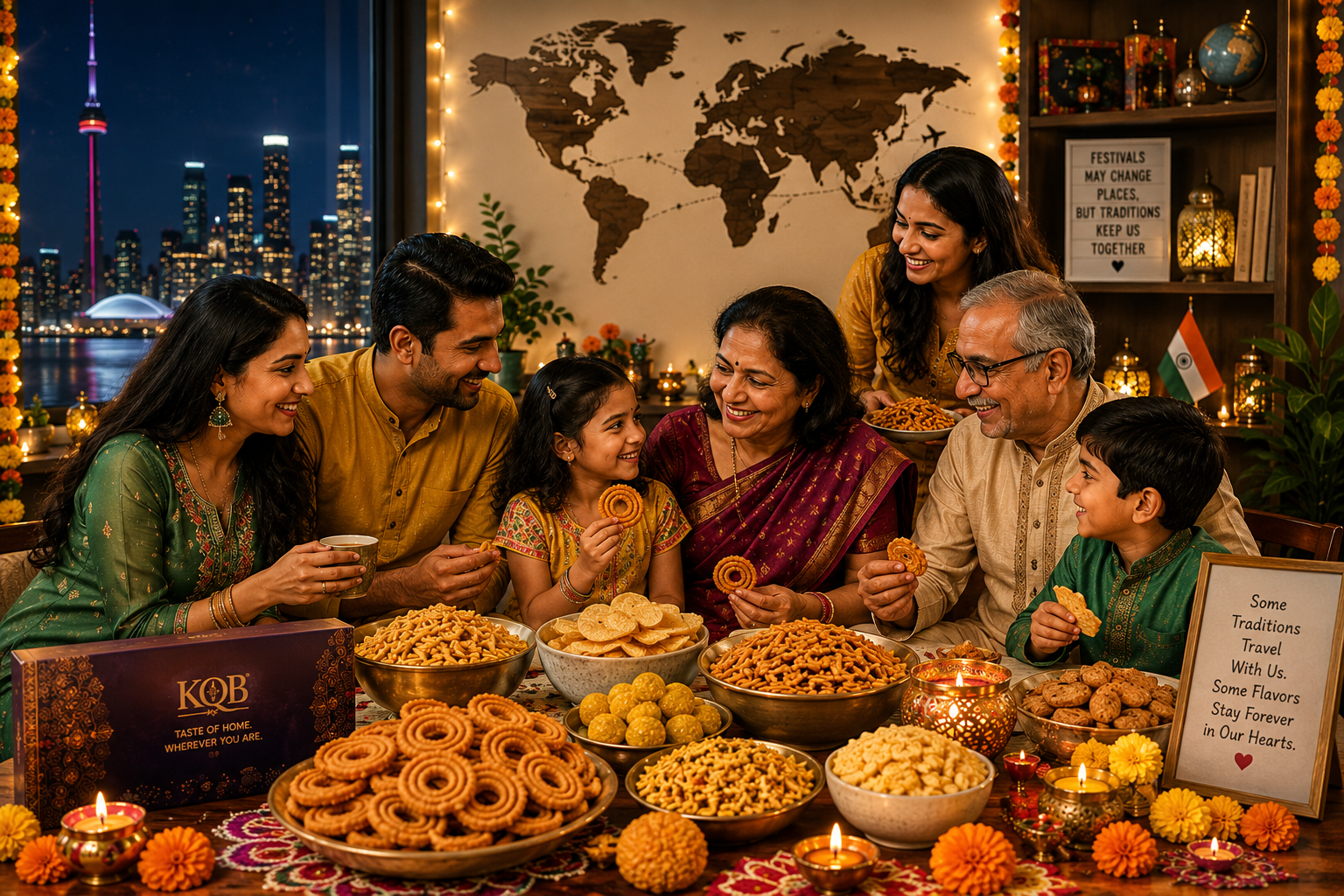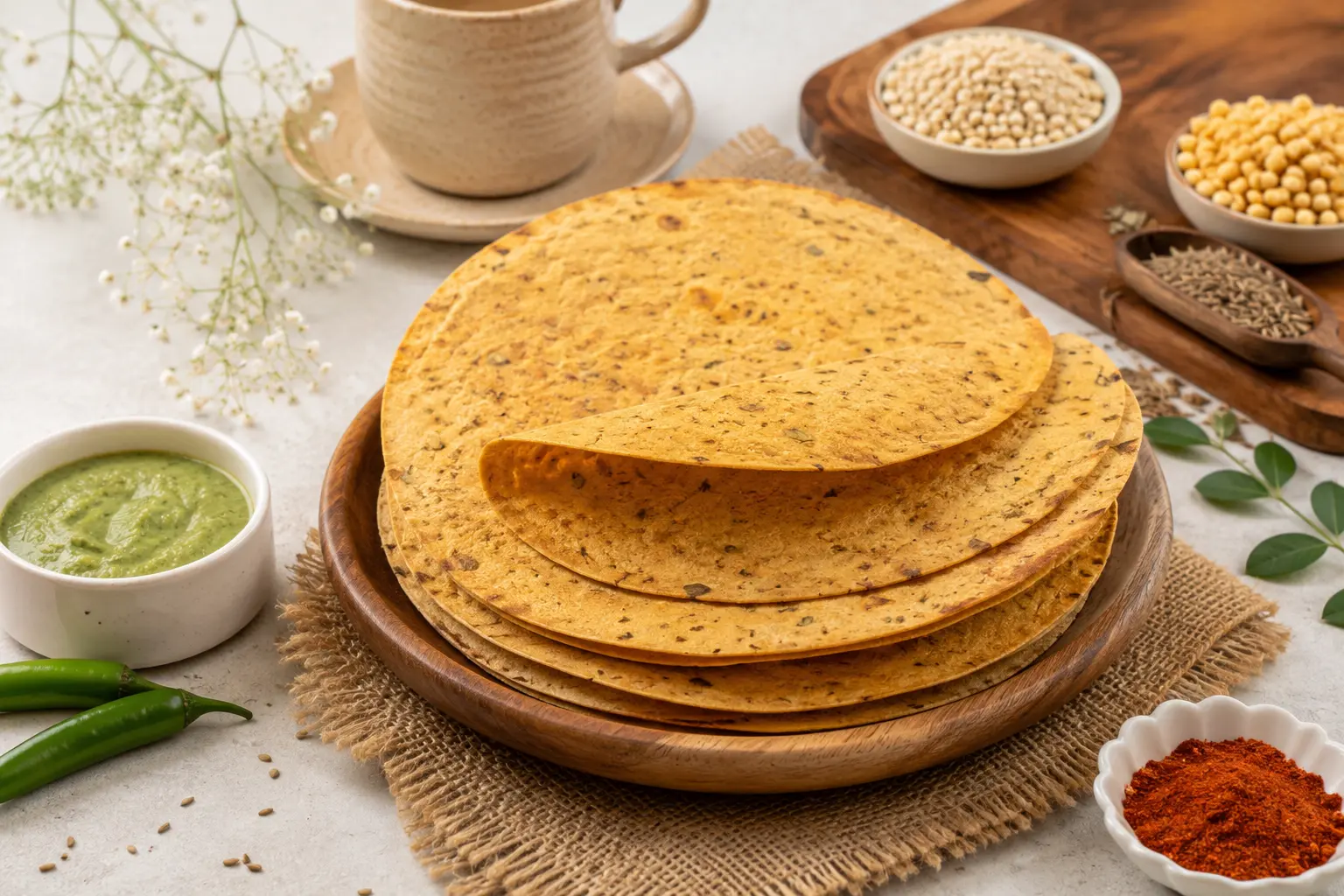
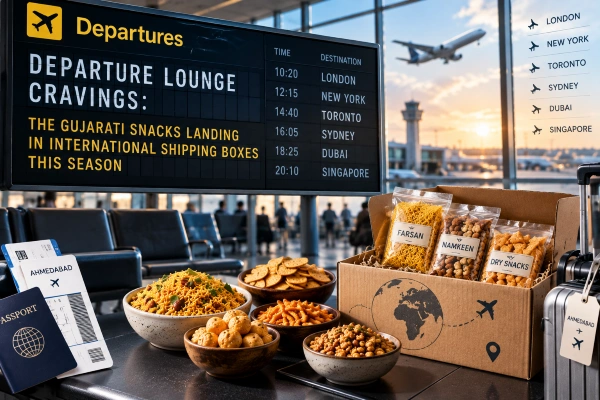
There’s a specific kind of shopping list that starts forming a few weeks before a flight back to the US, UK, Canada, or the Gulf — not clothes or gifts, but a very particular set of namkeen names scribbled down after a WhatsApp call with someone still in Gujarat. Increasingly, though, that list isn’t waiting for a flight at all. It’s going straight into an international order, shipped directly rather than carried back in a suitcase.

Looking at what’s actually landing in these international shipments — rather than assuming it’s just “whatever’s popular in India” — reveals a pattern shaped as much by shelf life and travel practicality as by taste alone.

Sev Orders Abroad Are Getting More Specific

A few years ago, an international order might have simply said “sev” and left it at that. That’s no longer really the case. Buyers abroad are now requesting specific variants by name, often because they’ve had a chance to try more than one and have settled on a clear favourite.

The Garlic Sev has become a particularly frequent international request, likely because its stronger, more distinct flavour holds up well even after weeks in transit, unlike more delicate variants that can lose some character over a long shipping window. The Jini Tikhi Sev shows up often too, usually from buyers who’ve specifically mentioned missing the sharper, spicier bite that’s harder to replicate with locally available Indian sev abroad. Meanwhile, the Palak Fudina Sev is gaining traction among households abroad trying to introduce their India-born parents’ generation of flavours to children who’ve grown up eating milder food overseas.

The dependable trio — Aloo Sev, Aloo Mari Sev, and Aloo Palakh Sev — still anchors most international orders, largely because they’re familiar enough to appeal across generations within the same household abroad.

Ganthiya Requests Are Increasingly Specific by Name

International orders for ganthiya have moved well past generic requests too. The Bhavnagari Ganthiya remains the most requested by far, often tied directly to recreating a Sunday jalebi-ganthiya breakfast that doesn’t quite feel the same with a generic substitute found in overseas Indian grocery stores. The Athanu Bhavnagari Ganthiya has also started appearing more frequently in repeat international orders, generally from buyers who’ve already tried the classic version and specifically gone looking for the tangier one afterward.

Shelf-Stable Regional Specialties Are Traveling Further Than Expected

Some items that might seem too regional to travel well internationally are turning up more often than expected. The Baroda No Lilo Chevdo is a good example — its herby, green-chilli flavour doesn’t fade much over a long shipping period, making it a solid choice for buyers who want something that tastes distinctly homemade rather than mass-produced. The Bardoli Na Dry Patra fits a similar pattern, appealing to households abroad who loved fresh patra back home but have no easy way to recreate it in a kitchen overseas — the dry, shelf-stable format solves that gap directly.

The Bhadran Moong is also seeing steady international demand, often from buyers specifically looking for a lighter, protein-forward snack that fits better with the more health-conscious eating habits many adopt after moving abroad.

Vacuum-Packed Bhakhri Is the Clear Winner for International Orders

If there’s one format that’s disproportionately favoured in international shipments compared to domestic orders, it’s vacuum-packed bhakhri. Given how much longer international shipping takes compared to a delivery within India, the difference in shelf life between regular and vacuum-sealed packaging becomes far more noticeable. The Bhakhri Jeera Vacuum and Bhakhri Mari Vacuum consistently outperform their standard counterparts in international orders for exactly this reason, while the regular Bhakhri Jeera, Bhakhri Mari, and Bhakhri Methi still get requested by buyers closer to a shipping route or those planning to consume them sooner after arrival.

Bhel: The One Item Ordered Purely on Impulse

Unlike almost everything else on this list, the Bhel doesn’t fit a neat travel-practicality pattern — it’s typically added to international orders somewhat spontaneously, usually by someone craving a taste of Indian street-style chaat that’s genuinely difficult to recreate with locally sourced ingredients abroad.

Why Understanding This Pattern Matters for International Buyers

Ordering Gujarati snacks internationally isn’t quite the same exercise as picking from a shelf in Ahmedabad. Shelf life, packaging format, and how well a flavour profile holds up over a longer transit window all play a bigger role than they would for a domestic buyer. Recognising which formats and variants tend to travel and hold up best — vacuum-packed bhakhri, robustly flavoured sev, and naturally shelf-stable items like chevdo and dry patra — helps international buyers get closer to the fresh, authentic experience they’re actually looking for.

KQB Food, based in Ahmedabad, ships this entire range internationally, sticking to the same traditional recipes that have made these snacks reliable repeat orders both within India and abroad. The full selection is available through their namkeen catalogue.

What’s landing in international shipping boxes right now tells a slightly different story than what’s simply “popular” in Ahmedabad — it’s shaped as much by what survives a long journey well as by taste alone. From increasingly specific sev requests to the clear preference for vacuum-packed bhakhri, these patterns reflect a diaspora that’s gotten more particular, not less, about getting the real thing. Explore the full range and place an order through KQB Food wherever you’re snacking from.

Frequently Asked Questions

1. Why do vacuum-packed bhakhri varieties perform better in international orders?

Vacuum sealing helps preserve freshness and crunch over the longer transit times involved in international shipping, unlike standard packaging.

2. Which sev variety travels best for international orders?

Garlic Sev and other robustly flavoured varieties tend to hold their taste and texture well over long shipping periods compared to more delicate options.

3. Are regional specialties like chevdo and dry patra suitable for international shipping?

Yes, naturally shelf-stable items like Baroda No Lilo Chevdo and Bardoli Na Dry Patra tend to travel well internationally without significant loss of flavour.

4. Why do international buyers request specific ganthiya varieties by name?

Many buyers abroad have already tried multiple varieties and developed a clear preference, often between the classic Bhavnagari Ganthiya and the tangier Athanu version.

5. Is bhel a common item in international Gujarati snack orders? 

Bhel tends to be ordered on impulse by those craving Indian street-style chaat, rather than as part of a routine or planned international order.

6. Where can I order authentic Gujarati snacks for international delivery? 

KQB Food, based in Ahmedabad, ships its full namkeen range internationally, available through their product catalogue.
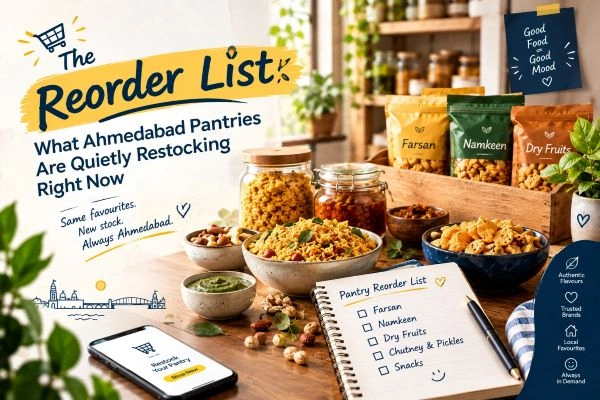
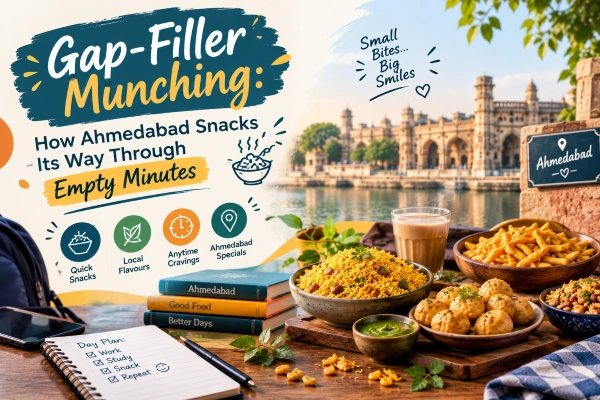
Every household has a shelf that never quite empties out the same way twice — some namkeen tins get refilled the moment they’re scraped clean, while others sit half-finished for weeks. Track that pattern across enough Ahmedabad kitchens, and a fairly consistent shortlist starts to emerge: the snacks that don’t just get bought once out of curiosity, but keep landing back in the cart order after order.

This isn’t a list of what’s technically “popular” in some abstract sense — it’s a look at what’s actually earning repeat orders right now, and why each one keeps making the cut.

The Sev Family Is Splitting Into Micro-Preferences

Sev used to be a fairly simple choice — plain besan or aloo, take it or leave it. That’s changed noticeably. Households are increasingly picking a specific sev variant based on mood or occasion rather than defaulting to whichever tin is already open, and that shift shows up clearly in reorder patterns.

The Jini Tikhi Sev has found a steady niche among people who specifically want something thin, sharp, and spicy rather than the softer, milder classics — it’s become the go-to for anyone topping a chaat or wanting a stronger bite in a mixture. The Garlic Sev has quietly built its own following too, particularly among buyers who’ve moved away from plain sev entirely in favour of something with a more pronounced, savoury edge. On the lighter end, the Palak Fudina Sev is showing up more often in households actively looking for something that feels a little fresher, thanks to the spinach and mint base cutting through the usual besan richness.

The everyday staples haven’t lost ground either — the Aloo Sev, Aloo Mari Sev, and Aloo Palakh Sev remain steady repeat purchases, largely because they work across age groups in the same household without needing a separate “adult” and “kid” tin.

Ganthiya Keeps Splitting Into Two Camps

Reorder data on ganthiya tends to split cleanly into two groups: those who stick to the classic, and those who’ve moved on to the tangier version. The Bhavnagari Ganthiya remains the anchor purchase for most households, particularly around weekends when jalebi-ganthiya breakfasts are still very much a routine. But the Athanu Bhavnagari Ganthiya has been gaining ground steadily among buyers who’ve developed a taste for its pickle-forward spicing, often ordering it specifically instead of, rather than alongside, the classic version.

Chevdo, Patra, and Moong Are Moving From Occasional to Regular

A few items that used to be occasional, festival-adjacent purchases have shifted into regular reorder territory. The Baroda No Lilo Chevdo is a clear example — once mostly associated with visits to or from Vadodara, it’s now a standing reorder for households that have simply gotten used to having it around. The Bardoli Na Dry Patra has followed a similar path, moving from “interesting to try once” to a repeat pick for anyone who’s come to prefer its dry, shelf-stable format over making fresh patra at home.

The Bhadran Moong shows a slightly different pattern — its repeat purchases are driven less by taste discovery and more by households actively trying to build a lighter, protein-leaning snack option into their weekly rotation, alongside the heavier fried classics.

Bhakhri’s Vacuum-Packed Versions Are Outpacing the Regular Ones

Among the more telling shifts is what’s happening with bhakhri. The core flavours — Bhakhri Jeera, Bhakhri Mari, and Bhakhri Methi — remain steady, but a growing share of repeat orders are specifically for the vacuum-packed versions, like Bhakhri Jeera Vacuum and Bhakhri Mari Vacuum. This lines up with how bhakhri is actually being used now — less as a pantry staple eaten at home, and more as something packed for train journeys, tiffins, and gifting, where the extra shelf life of a sealed pack genuinely matters.

Bhel Is the Wildcard Reorder

Unlike the rest of this list, the Bhel doesn’t follow a predictable pattern tied to season or occasion — it gets reordered impulsively, usually right after someone’s had a craving for street-style chaat and doesn’t want to deal with assembling it from separate ingredients. Its repeat-purchase behaviour looks more like a snack food than a namkeen, which is part of why it keeps showing up on carts that otherwise look nothing alike.

What Ties These Reorders Together

Looking across this list, the common thread isn’t really flavour or price — it’s that each of these items has found a specific, recurring use case in someone’s routine, whether that’s a weekend breakfast ritual, a travel snack, a lighter alternative, or an impulsive craving fix. That’s generally a better signal of genuine demand than a one-time bestseller list, since it reflects what people actually keep coming back for rather than what they tried once.

KQB Food carries this entire range, made using the same traditional recipes that have kept these items in steady rotation across Ahmedabad households. You can browse the full namkeen selection through their product catalogue.
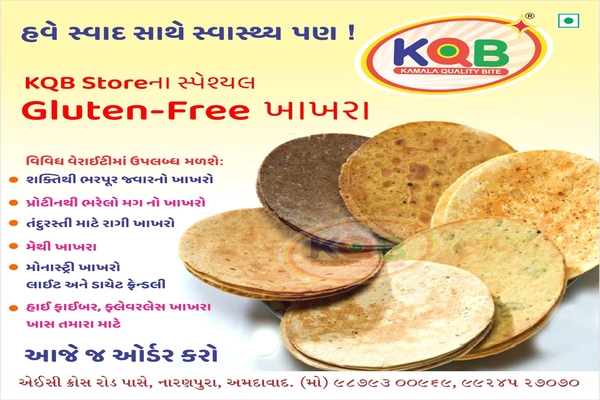
Reorder patterns tend to say more about a snack’s actual staying power than any single sales spike ever could. From the growing split within the sev family to bhakhri’s shift toward vacuum-packed formats, what Ahmedabad households keep restocking says a lot about how their everyday snacking habits are quietly evolving. Explore the full range and see which of these has already earned a permanent spot in your own rotation at KQB Food.

Frequently Asked Questions

1. Why are vacuum-packed bhakhri varieties becoming more popular than regular ones?

Vacuum-packed bhakhri holds its crunch and freshness longer, making it better suited for travel, tiffins, and gifting compared to regular packaging.

2. What’s driving demand for tangier ganthiya options like Athanu Bhavnagari Ganthiya? 

Buyers who’ve developed a preference for pickle-style, spiced flavours are increasingly choosing tangier ganthiya variants over the classic version.

3. Is chevdo still considered a regional specialty or an everyday snack now?

While chevdo varieties like Baroda No Lilo Chevdo originated as regional specialties, they’ve increasingly become regular household staples rather than occasional purchases.

4. Why do some households prefer moong-based snacks over fried besan options?

Moong-based snacks like Bhadran Moong offer a lighter, protein-forward alternative for households balancing traditional flavours with lighter snacking habits.

5. What makes bhel different from typical reordered namkeen?

Bhel tends to be purchased impulsively based on cravings rather than as part of a routine restocking pattern, unlike more habitual namkeen purchases.

6. Where can I order these trending Gujarati snacks online?

The full range, including sev varieties, ganthiya, chevdo, bhakhri, and bhel, is available through KQB Food’s namkeen collection.

Ahmedabad has a word for a very specific kind of eating that doesn’t happen at mealtime, isn’t tied to hunger, and doesn’t need a reason: timepass. It’s what happens on a terrace after dinner, at a bus stop while waiting for a friend who’s running late, during a power cut when the TV’s off and there’s nothing to do but talk, or scrolling through a phone on a lazy Sunday afternoon with absolutely no agenda. The food that fits into these moments is its own category entirely — light, crunchy, instantly satisfying, and gone from the packet before you’ve even noticed you finished it.

This is a look at that specific habit — not as a snack list, but as the small, empty stretches of time it actually fills — along with where to get the real thing online.

The Five-Minute Window

Timepass snacking rarely lasts long. It fills the exact stretch between one thing ending and another beginning — the ad break, the wait for the kettle to boil, the ten minutes before a video call starts. Because the window is so short, the snack itself has to deliver everything immediately: no assembly, no side dish, no waiting. Just tear, crunch, repeat.

This is exactly why fryums and rings have held their place in Ahmedabad’s snacking habits for so long. The Appu Fryums hit that instant, airy crunch that disappears from the bowl faster than most people realise, while the Manchurian Ring and Tomato Ring bring a sharper, more distinct flavour hit for anyone who wants their five minutes of timepass to actually taste like something memorable. On warmer evenings, the Pudina Rings add a cooling mint edge that somehow makes doing absolutely nothing feel slightly more refreshing.

The Longer Stretch

Not all timepass is five minutes, though. Some of it is an hour of waiting at a railway station, a long autorickshaw ride across the city, or an entire lazy afternoon with nowhere particular to be. This calls for something with a bit more chew and staying power — snacks that can be picked at slowly rather than finished in one go.

The Soya Stick and Tomato Stick are built exactly for this — firmer, more filling, and satisfying enough to stretch across a longer stretch of idle time without feeling like a full meal. The Soya Chips offer a flatter, thinner alternative for the same kind of extended, unhurried snacking, especially popular during long study sessions or slow work-from-home afternoons.

The Corner Everyone Secretly Prefers

Ask around, and most people will admit that the flavoured, cheesy end of the snack shelf is where their hand actually goes first, even if they claim to prefer something “healthier.” The Cheese Ball and both Cheese Popcorn and Cheese Popcorn options have become the default choice for movie nights at home, weekend get-togethers, and pretty much any occasion that calls for a shared bowl in the middle of the table. For those who prefer the original, uncomplicated version, the Classic Salted Popcorn still holds its own, proving that not every timepass craving needs a bold flavour twist. And when someone specifically asks for a snack by name rather than picking whatever’s closest, it’s almost always the Kurkure that gets requested first.

Timepass Is Rarely a Solo Activity

There’s also a social side to this that often gets overlooked. A lot of timepass snacking happens in twos and threes — friends catching up on a terrace, cousins during a power cut, colleagues stretching a tea break a few extra minutes. In these settings, the snack becomes less about individual taste and more about having enough variety on hand that everyone reaching into the same bowl finds something they actually like.

This is where keeping a small mix on hand pays off more than committing to just one packet. A shared bowl with a bit of Kurkure, a handful of cheese balls, and a scoop of classic salted popcorn tends to disappear faster and generate more conversation than any single snack on its own — proof that even something as small as timepass snacking has its own unspoken social etiquette in Ahmedabad.

Why Timepass Snacking Deserves Better Than Whatever’s Nearby

Most people default to whatever snack happens to be within arm’s reach during these idle moments, which usually means settling for something average simply because it was convenient. But since timepass eating happens so often — arguably more frequently than any planned meal — it’s worth stocking a proper rotation of options rather than relying on whatever’s left in the cupboard.

KQB Food, made right here in Ahmedabad, brings together this entire range of fryums, rings, sticks, popcorn, and more in one place, so restocking for the next round of timepass doesn’t mean settling for less than the real thing. Browse the full range and order directly through KQB Food’s catalogue.

Timepass isn’t really about the snack — it’s about the moment it fills: the wait, the pause, the stretch of nothing-in-particular that makes up a surprising amount of everyday life in Ahmedabad. Whether it’s a quick five-minute fryum fix or a slow afternoon with a bag of soya sticks, having the right options on hand turns idle time into something genuinely enjoyable. Order the complete timepass range from KQB Food and keep those in-between moments a little more interesting.

Frequently Asked Questions

1. What does “timepass” mean in the context of snacking?

Timepass refers to eating done purely to fill idle or waiting periods, unrelated to regular mealtimes, and typically involves light, crunchy, instantly satisfying snacks.

2. What’s the difference between fryums, rings, and sticks?

Fryums are light, airy, and quick to finish, rings offer a bolder flavour hit in a similar light format, while sticks are firmer and more filling, suited for longer snacking stretches.

3. Which timepass snacks work best for movie nights or group gatherings?

Cheese-flavoured options like cheese balls and cheese popcorn tend to be the most popular choices for shared snacking during movie nights or casual get-togethers.

4. Are there lighter, less heavily flavoured timepass snack options available?

Yes, classic salted popcorn offers a simpler, less intense flavour profile for those who prefer a more traditional snacking option.

5. Why do people prefer ordering timepass snacks in bulk rather than one at a time?

Since timepass eating happens frequently throughout the week, keeping a rotation of different snacks on hand avoids settling for whatever’s left over or convenient at the moment.

6. Where can I order authentic Ahmedabad-made timepass snacks online?

The complete range, including fryums, rings, sticks, and popcorn, is available for order through KQB Food’s product catalogue.

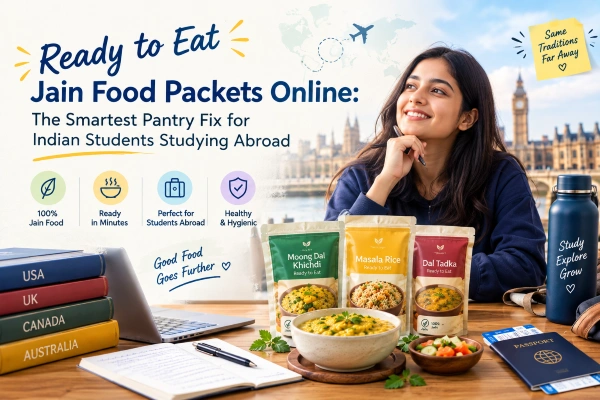
Move a Jain student into a university dorm anywhere outside India, and within the first month a very specific pattern shows up: skipped meals, endless bowls of plain rice or pasta, and a growing pile of instant noodles that are “safe” mostly because there’s nothing to check for onion or garlic in the first place. Between shared kitchens, tight budgets, unpredictable class schedules, and zero access to Jain-specific ingredients, sticking to a proper Jain diet while studying abroad is one of the more underrated struggles international students deal with.

This is exactly why searches for ready-to-eat Jain food packets online spike heavily during exam season and right after students land abroad for the first time—it’s less about convenience and more about having one reliable way to eat properly without a fully equipped kitchen, extra grocery runs, or hours to spare.

Why Dorm Life Makes Jain Eating Especially Hard

Most student housing comes with limited cooking equipment, shared fridge space, and kitchens that are busiest exactly when everyone wants to cook — right before or after classes. For a Jain student, that already tight window gets tighter, since cooking a proper Jain meal from scratch means sourcing asafoetida, the right spice ratios, and vegetables that exclude anything root-based, none of which are guaranteed to be available at a regular international grocery store near campus.

Add exam weeks, part-time jobs, and irregular schedules into the mix, and the realistic outcome for a lot of Jain students isn’t “cook a full meal every day”—it”‘s “eat something that doesn’t compromise on diet, quickly, on a day when there’s genuinely no time to cook.”

What to Look for When Ordering Jain Food as a Student Abroad

Budget and shelf life matter more for students than for most other buyers. Vacuum-sealed or dehydrated packets that don’t need refrigeration are ideal for shared dorm fridges with limited space, and a longer shelf life means fewer, larger orders instead of constant restocking. It’s also worth checking preparation time specifically—between classes, part-time work, and assignments, a meal that needs a 20-minute cook isn’t realistic on most weekdays, while something ready in under 10 minutes actually gets used.

The Jain Ready-to-Eat Range That Fits a Student Schedule

For mornings before an early lecture, the Jain Poha and Jain Upma are about as practical as breakfast gets—quick to prepare, light enough to eat before class, and familiar enough to feel like a proper meal rather than another packaged snack grabbed on the way out.

For dinners squeezed between library sessions or part-time shifts, the Jain Paneer Butter Masala delivers a genuinely satisfying, restaurant-style meal without needing a fully stocked kitchen — just a pan or hot water and a few minutes. The Jain Palak Paneer works as a slightly lighter alternative for students trying to balance hostel food fatigue with actual nutrition, especially useful during exam weeks when proper meals tend to get skipped altogether.

And for the specific craving that hits almost every Indian student abroad at some point, the Jain Pav Bhaji solves a problem most students assume has no solution overseas—a properly made, onion-and-potato-free version of a dish that’s otherwise nearly impossible to find outside India, let alone in Jain-compliant form.

Making These Work in a Shared Kitchen

Most of this range is built for minimal equipment—a single pan, a kettle, or even just hot water for boil-in-pouch preparation, which matters when shared kitchen access is limited or inconvenient. Keeping a small stock of Jain Poha and Upma for mornings, alongside a couple of Paneer Butter Masala or Pav Bhaji packets for busier evenings, covers a realistic week without needing daily access to a full kitchen setup or a long prep window between classes.

Why This Matters Beyond Just Convenience

For a lot of Jain students, this isn’t only about food — it’s one of the few consistent threads connecting them to home during an otherwise disorienting first year abroad. Skipping meals or constantly compromising on diet tends to add up quietly over a semester, showing up as fatigue, poor concentration during exams, or simply a growing sense of being unable to eat “normally” the way they did at home. Having a reliable, properly made Jain option removes that friction, letting food be one less thing to manage on top of an already demanding academic schedule.

Ordering for International Student Delivery

KQB Food, based in Ahmedabad, ships its Jain-friendly range internationally in vacuum-sealed, shelf-stable packaging built to handle longer transit times—a practical fit for students who’d rather place one larger order per semester than repeatedly hunt for Jain ingredients locally. The full range, including poha, upma, paneer dishes, and pav bhaji, is available on the Dehydrated & Ready-to-Eat Food category page, alongside additional Jain dal and khichdi options worth adding to a semester-long order.

For Jain students abroad, the search for ready-to-eat Jain food packets online usually comes down to a simple need—eating properly without a full kitchen, a big grocery budget, or hours of free time between classes. With a dedicated range covering breakfast, comfort-food dinners, and even a Jain-friendly pav bhaji fix, ordering from an Ahmedabad-based source like KQB Food means one less thing to worry about during an already demanding academic year.

Frequently Asked Questions

1. Why is it hard for Jain students to eat properly while studying abroad? 

Limited kitchen access, tight budgets, unpredictable schedules, and the unavailability of Jain-specific ingredients like asafoetida make daily Jain cooking difficult in most student housing abroad.

2. Can ready-to-eat Jain food packets be prepared in a shared dorm kitchen?

Yes, most are designed for minimal equipment, needing only a pan, kettle, or hot water for boil-in-pouch preparation, making them suitable for shared or limited kitchen setups.

3. How long do vacuum-sealed Jain ready-to-eat packets last, and are they good for bulk student orders?

Vacuum-sealed, dehydrated packets typically have a considerably longer shelf life than fresh food, making them practical for students to order in bulk once per semester rather than restocking frequently.

4. Is Jain pav bhaji available in ready-to-eat form for students abroad?

Yes, a properly made Jain pav bhaji, prepared without onion or potato, is available as a ready-to-eat packet, addressing a dish that’s otherwise very hard to find abroad.

5. What are the quickest Jain ready-to-eat options for busy exam weeks?

Jain Poha and Jain Upma are the fastest to prepare, making them practical breakfast or light-meal options when time is limited during exams.

6. Where can international students order authentic Jain ready-to-eat food packets online?

KQB Food’s Jain range, including paneer dishes, pav bhaji, poha, and upma, ships internationally and is available through their ready-to-eat food collection.

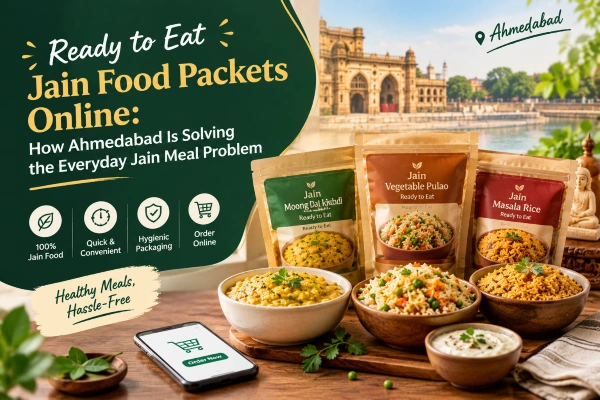
Anyone following a strict Jain diet knows the specific frustration of eating out — scanning menus for anything without onion, garlic, or root vegetables, only to end up ordering the same two or three “safe” dishes every single time. It’s a problem that doesn’t go away at home either, especially on days when there’s no time to cook a full Jain meal from scratch. This is exactly the gap that searches for ready to eat Jain food packets online are trying to solve, and Ahmedabad — home to one of India’s largest and most food-conscious Jain communities — has quietly become the place where this problem is being solved properly.

This guide looks at what actually makes a ready-to-eat Jain packet worth ordering, and which specific products are worth adding to your pantry.

Why “Ready to Eat” Is Different for Jain Food

Ready-to-eat food already has a mixed reputation — often too salty, too processed, or simply not close enough to home-cooked taste to justify the convenience. That gap gets even wider for Jain food, because most mainstream ready-to-eat brands either skip Jain options entirely or make half-hearted attempts that use onion powder or garlic-derived flavouring under generic labels.

A genuinely good Jain ready-to-eat product has to solve two problems at once: staying completely free of onion, garlic, and root vegetables like potato in dishes that traditionally rely on them for flavour and texture, while still tasting close enough to the original that it doesn’t feel like a compromise. That second part is where most attempts fall short — and it’s the specific reason demand for ready to eat Jain food packets online keeps growing, since people are actively looking for brands that get this right rather than settling for whatever’s available locally.

What to Look for Before Ordering Jain Ready-to-Eat Packets Online

Before adding anything to cart, a few checks are worth making. First, confirm the product is explicitly labelled Jain, not just “vegetarian,” since the two are not the same thing. Second, look at how the flavour is built without onion and garlic — good Jain cooking typically compensates with ingredients like asafoetida (hing), ginger, and specific spice ratios rather than skipping flavour altogether. Third, check the packaging format; vacuum-sealed, shelf-stable pouches with clear rehydration or heating instructions tend to hold up far better than simple sealed trays.

The Jain Ready-to-Eat Range Worth Ordering

KQB Food’s Jain range covers both comfort-food staples and richer restaurant-style dishes, all made strictly without onion, garlic, or root vegetables.

For a quick breakfast or evening snack, the Jain Poha and Jain Upma are two of the most practical options in the entire category. Both are dishes that Jain households already eat regularly, but making them fresh every single morning isn’t always realistic — having a ready-to-eat version means the same familiar breakfast is available in minutes, without hunting for onion-free versions of spice mixes.

On the richer side, the Jain Paneer Butter Masala recreates the classic North Indian restaurant favourite using a tomato-cashew base built up without onion or garlic, relying instead on the right balance of spice and cream to get the depth right. The Jain Palak Paneer follows the same principle, using a properly seasoned spinach gravy that doesn’t lean on onion for its base flavour, which is where many home attempts at Jain palak paneer tend to fall flat.

For anyone who’s had to skip street food specifically because of pav bhaji’s typically onion-heavy base, the Jain Pav Bhaji is worth calling out on its own. Pav bhaji is one of the hardest dishes to convincingly “Jain-ify” since so much of its flavour traditionally comes from a well-cooked onion-tomato base — getting this right, without potato either, is a genuine test of a brand’s Jain cooking expertise.

Who’s Actually Searching for This

The demand behind ready to eat Jain food packets online isn’t limited to one type of buyer. Jain students living away from home for college, working professionals in cities without easy access to Jain-specific restaurants, elderly parents who want quick, familiar meals without daily cooking, and even non-Jain households looking to reduce onion-garlic intake for personal or health reasons all show up in this search category. Ahmedabad, with its dense Jain population and strong food manufacturing base, has ended up as a natural hub for brands solving this specific need well.

How to Prepare These for the Best Result

Most ready-to-eat Jain packets, including this range, are designed for quick heating — either a short boil-in-pouch method or a stovetop warm-up after opening. Pairing something like Jain Paneer Butter Masala or Jain Palak Paneer with fresh rotis, and Jain Pav Bhaji with toasted pav, closes most of the remaining gap between “ready-to-eat” and “home-cooked,” while poha and upma need little more than a quick reheat and a garnish of fresh coriander or lemon if available.

Ordering the Full Jain Range Online

KQB Food makes its entire Jain-friendly range available for online ordering directly from Ahmedabad, covering everything from quick breakfasts like poha and upma to full dinner options like paneer butter masala, palak paneer, and pav bhaji. You can browse the complete lineup, including additional Jain dal and khichdi options, on the Dehydrated & Ready-to-Eat Food category page.

The search for ready to eat Jain food packets online usually comes from a very specific, recurring problem — wanting a proper meal without spending time hunting for onion-and-garlic-free options every single time. With a dedicated range covering breakfast, paneer dishes, and even Jain-friendly pav bhaji, ordering directly from an Ahmedabad-based maker like KQB Food means that problem gets solved once, rather than every time hunger strikes.

Frequently Asked Questions

1. What makes food “Jain” rather than just vegetarian?

Jain food excludes onion, garlic, and root or underground vegetables like potato, in addition to meat and eggs, following dietary principles rooted in minimising harm to living organisms.

2. Are ready-to-eat Jain food packets healthy?

Quality varies by brand, but well-made Jain ready-to-eat packets that avoid excessive preservatives and use proper Jain-compliant ingredients can be a reasonably balanced option for quick meals.

3. How is flavour maintained in Jain food without onion and garlic?

Good Jain cooking typically relies on asafoetida (hing), ginger, and carefully balanced spice combinations to replicate depth of flavour that onion and garlic would otherwise provide.

4. Can ready-to-eat Jain pav bhaji really taste authentic without onion or potato?

It depends heavily on preparation technique — a well-made version compensates with a thicker tomato-based mix and the right spice blend, though it will differ slightly from traditional onion-potato pav bhaji.

5. Are Jain poha and upma available as ready-to-eat options?

Yes, ready-to-eat Jain poha and upma are available for quick breakfast or snack preparation without needing to source onion-free spice mixes separately.

6. Where can I order authentic ready-to-eat Jain food packets online in India?

KQB Food, based in Ahmedabad, offers a full range of Jain ready-to-eat meals, available through their dehydrated and ready-to-eat food collection.

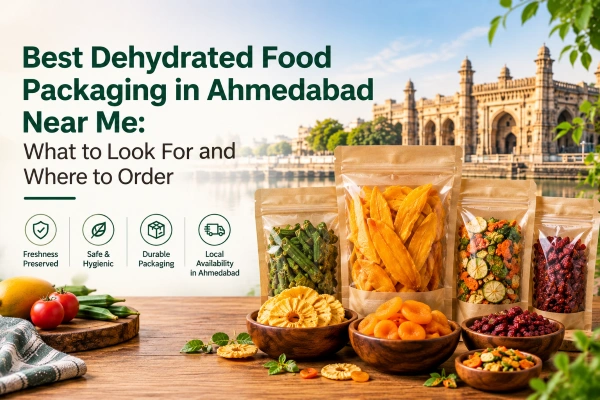
Type “best dehydrated food packaging Ahmedabad near me” into Google and you’ll notice something quickly—most results either talk about industrial packaging machinery or generic freeze-dried snack brands with no real connection to the city. If you’re actually looking for well-packaged, ready-to-eat dehydrated food made in Ahmedabad — the kind you can stock in a pantry, carry on a trek, or keep on hand for busy weeknights — the search gets a lot less specific than it should be.

This guide breaks down what actually makes dehydrated food packaging good, why it matters more than people realise, and where to find a genuinely local, Ahmedabad-based option that gets both the food and the packaging right.

What Makes Dehydrated Food Packaging “Good” in the First Place

Dehydrated and freeze-dried food lives or dies on its packaging. Unlike regular packaged snacks, dehydrated meals depend entirely on staying moisture-free to retain both their texture and their shelf life — a poorly sealed pack can turn a perfectly good dal khichdi into something clumpy or stale within weeks, regardless of how well the food itself was prepared.

Good dehydrated food packaging typically covers a few non-negotiables: airtight, multi-layer pouches that block moisture and light, proper vacuum sealing to remove excess air, portion sizing that matches how the food will actually be reconstituted, and clear instructions for rehydration since most of these products are meant to be prepared quickly with hot water. When any one of these is missing, the “shelf-stable” promise on the label doesn’t really hold up in practice.

Why This Matters More in a City Like Ahmedabad

Ahmedabad’s climate — long stretches of heat followed by humid monsoon months — makes packaging quality especially important for anything meant to sit in a pantry for weeks or months. Food that’s dehydrated but poorly packaged doesn’t just lose freshness faster here; it’s also more prone to picking up moisture during the monsoon, which defeats the entire purpose of choosing a dehydrated product in the first place.

This is also why searching specifically for a local Ahmedabad-based source matters, rather than ordering from a distant supplier whose packaging may not have been tested against local storage and transit conditions.

Ready-to-Eat Dehydrated Meals Worth Knowing About

Beyond just packaging, the actual value of good dehydrated food comes down to how close it gets to home-cooked taste once rehydrated. KQB Food’s ready-to-eat range covers a solid spread of everyday Indian meals designed for exactly this — quick preparation without sacrificing flavour.

For comfort-food basics, there’s the Dal Chawal and Dal Khichdi Ready to Eat, both built around the kind of simple, digestible meal most Indian households turn to on a tiring day. The Gujarati Dal Ready to Eat brings the specific sweet-tangy profile of Gujarati dal into a shelf-stable format, which is genuinely hard to find pre-made outside the region.

For richer options, the Dal Makhani Ready to Eat and its Jain counterpart, the Jain Dal Makhani Ready to Eat and Jain Dal Makhani, cater to different dietary preferences without dropping the dish’s signature creaminess. Similarly, the Jain Khichdi Kadhi and Jain Masala Khichdi Kadhi give Jain households a proper khichdi-kadhi combination without onion or garlic, which is often difficult to find in ready-to-eat form.

The range extends into North Indian favourites too, with Jain Paneer Butter Masala and a second variant, Jain Paneer Butter Masala, alongside Jain Paneer Lababdar, Jain Palak Paneer and its alternate version Jain Palak Paneer, and Jain Paneer Bhurji. Rounding out the street-food side, there’s Jain Pav Bhaji and a second Jain Pav Bhaji option — a genuinely useful find for Jain families who otherwise have to skip pav bhaji entirely when eating out.

Who Actually Needs Well-Packaged Dehydrated Food

It’s easy to assume dehydrated food is only for trekkers and travellers, but the real demand in a city like Ahmedabad is broader than that. Working professionals who want a proper meal ready in minutes, students living away from home, elderly parents who need quick, digestible food without daily cooking effort, and families stocking up before travel or unpredictable weeks all rely on this category more than people expect.

Jain households in particular benefit from a dedicated ready-to-eat range, since finding onion-and-garlic-free packaged meals — especially in richer preparations like paneer butter masala or pav bhaji — is far harder than finding standard versions.

What to Check Before You Buy Locally

If you’re specifically searching for “dehydrated food packaging near me” in Ahmedabad, a few quick checks help separate genuinely good options from ones riding on the freeze-dried trend without the packaging quality to back it up: look for vacuum-sealed or multi-layer pouches rather than simple plastic bags, check that the pack states a realistic shelf life rather than a vague “long-lasting” claim, and confirm rehydration instructions are clear and specific rather than generic.

KQB Food operates directly out of Ahmedabad and pairs its dehydrated and ready-to-eat range with dedicated vacuum packaging expertise, which is exactly the combination worth looking for when the search is about packaging quality as much as the food itself. The full lineup, including all the dal, khichdi, and paneer options above, is available on the Dehydrated Food (Freeze-Dried Food) category page.

“Best dehydrated food packaging near me” isn’t really a question about finding the fanciest pouch design — it’s about finding food that stays genuinely fresh in Ahmedabad’s climate, rehydrates properly, and actually tastes like something homemade rather than a compromise. Between a wide Jain-friendly ready-to-eat range and packaging built for local storage conditions, KQB Food covers both sides of that search. Explore the complete dehydrated food range and see which ready-to-eat meal earns a permanent spot in your pantry.

Frequently Asked Questions

1. What makes dehydrated food packaging different from regular food packaging?

Dehydrated food packaging relies on airtight, moisture-blocking, multi-layer pouches and vacuum sealing to preserve texture and shelf life, since even small amounts of moisture can spoil the product.

2. Why does climate matter for dehydrated food storage in Ahmedabad?

Ahmedabad’s heat and monsoon humidity can compromise poorly sealed packaging faster than in drier or more temperate regions, making proper vacuum and moisture-barrier packaging essential.

3. Are ready-to-eat dehydrated meals suitable for Jain diets?

Yes, several ready-to-eat options, including Jain dal makhani, Jain khichdi kadhi, and Jain paneer preparations, are made without onion and garlic to suit Jain dietary requirements.

4. How long do vacuum-packed dehydrated meals typically last?

Shelf life varies by product, but properly vacuum-sealed dehydrated meals generally last significantly longer than fresh food when stored in a cool, dry place — check the specific product packaging for exact duration.

5. Who typically buys ready-to-eat dehydrated food?

Working professionals, students, travellers, elderly individuals living alone, and families stocking up for busy or unpredictable weeks are among the most common buyers.

6. Where can I find well-packaged dehydrated and ready-to-eat food in Ahmedabad?

KQB Food, based in Ahmedabad, offers a full range of dehydrated and ready-to-eat meals paired with dedicated vacuum packaging, available on their dehydrated food category page.

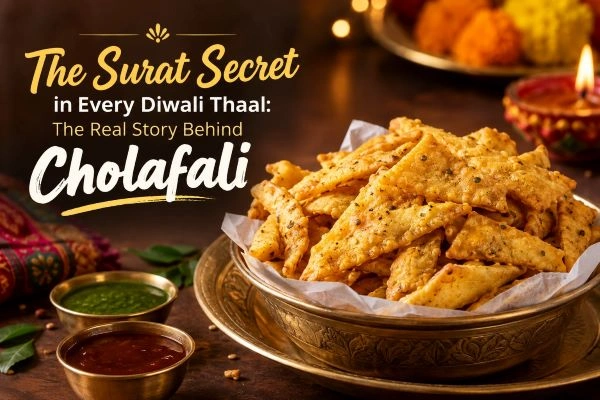
Most people who eat cholafali every Diwali have never actually asked where it came from — it just appears on the farsan thaal, gets devoured in minutes, and shows up again the following year like clockwork. But cholafali has a specific, traceable origin story, and understanding it explains a lot about why this particular snack became a festival fixture rather than just another item in Gujarat’s enormous namkeen catalogue.

With Diwali 2026 arriving on Sunday, November 8, and the festivities running from Dhanteras on November 6 through Bhai Dooj on November 10, this is a good moment to look at cholafali not just as something to order, but as a snack with a genuine craft behind it — one that’s worth understanding before it lands on your farsan plate this year.

Where Cholafali Actually Comes From

Cholafali is widely credited to Surat, a city that has historically punched above its weight when it comes to Gujarati food innovation — the same city that gave Gujarat locho, ghari, and undhiyu as we know it today. Surti cooks are known for taking relatively simple ingredients and applying an almost obsessive level of technique to them, and cholafali is a textbook example of that approach.

Unlike ganthiya or sev, which rely mainly on the right spice mix and frying temperature, cholafali depends heavily on how thin the dough sheets are rolled before frying. Traditionally, skilled cholafali makers in Surat could roll the urad-moong dal dough thin enough that it would puff up into an almost transparent, glass-like sheet the moment it hit hot oil — a skill that took years to master and is still considered a mark of quality today. This is why authentic cholafali has such a distinct, delicate texture compared to other fried Gujarati snacks; it’s essentially a technique-driven food, not just a recipe-driven one.

How Cholafali Travelled From Surat to Every Gujarati Home

As Gujarati families moved between cities — Surat to Ahmedabad, Ahmedabad to Vadodara, and eventually across India and abroad — cholafali travelled with them, carried both as a physical gift and as a recipe passed down through households. Over time, it stopped being a “Surti specialty” and became a pan-Gujarati festival staple, particularly for Diwali, when families wanted something that felt a little more special than everyday farsan.

What helped cement its place at Diwali specifically is practical: cholafali doesn’t get made casually on a random Tuesday. Because of the skill and time the thin-rolling technique demands, it has historically been reserved for occasions worth the effort — weddings, Diwali, and other major family gatherings. That association has stuck, which is why cholafali still feels like an “occasion snack” even now, when most Gujarati households buy it ready-made rather than rolling it by hand.

The Flavour That Makes Cholafali Different

What separates cholafali from nearly every other item on a Diwali farsan plate is its layered taste. The base is savoury and mildly earthy from the urad and moong dal, but it’s finished with black salt, coarsely ground black pepper, and a light sugar-lime syrup brushed across the surface — giving it a sweet-tangy-spicy hit that changes with every bite, depending on which part of the sheet you’re eating.

This is a deliberate contrast to the rest of a typical Gujarati Diwali spread, which tends to lean heavily savoury (ganthiya, sev, mathiya) or heavily sweet (mithai). Cholafali sits in between, which is exactly why it doesn’t get skipped even when the plate is already full — it offers something the rest of the thaal doesn’t.

Two Ways to Experience Cholafali This Diwali

KQB Food keeps this traditional Surat-style preparation intact across its cholafali range, giving you two ways to experience the snack depending on preference. The Cholafali follows the classic thin-rolled, lightly fried style — the version closest to what you’d find at an old-school Surat farsan shop, with that signature delicate crunch and balanced sweet-spice finish.

For those who prefer a heartier bite, the Fried Cholafali takes the same base preparation through a deeper fry, resulting in a firmer, more robust crunch that holds up especially well in Diwali gift boxes and during the five days of guest visits when a container might be opened and closed repeatedly.

Why This Origin Story Matters When You’re Buying Cholafali

Knowing where cholafali comes from is more than trivia — it’s actually a useful way to judge quality. Because the entire identity of cholafali rests on how thin and evenly it’s rolled before frying, poorly made versions tend to be thicker, chewier, or unevenly puffed, losing the glass-like crispness that defines the real thing. When you’re ordering online, especially ahead of a busy festival like Diwali, sourcing from a maker that respects that original Surat technique — rather than a generic, mass-produced version — makes a noticeable difference in the final bite.

This is where KQB Food has built its reputation within Gujarat’s namkeen space: sticking to traditional preparation methods across its farsan range rather than cutting corners for scale. You can explore the full selection on the Cholafali category page, or browse the wider Papad/Mathiya section to round out your Diwali farsan order.

Cholafali’s journey from a Surat specialty to a Diwali essential across Gujarat is really a story about craft outlasting convenience — a snack that stuck around specifically because it was harder to make well, not easier. As Diwali 2026 approaches on November 8, that history is worth remembering the next time a plate of cholafali gets passed around your Diwali gathering. Order the authentic version, in both classic and fried styles, from KQB Food and bring a genuine piece of Surti craftsmanship to this year’s farsan thaal.

Frequently Asked Questions

1. Which city is cholafali originally from?

Cholafali is widely credited to Surat, a city known for its intricate, technique-heavy approach to Gujarati snacks and sweets.

2. Why is cholafali associated with special occasions rather than everyday snacking?

Its preparation requires skillfully rolling the dough into extremely thin sheets before frying, a time-consuming technique traditionally reserved for weddings, Diwali, and other major celebrations.

3. What gives cholafali its distinctive taste?

Cholafali is finished with black salt, black pepper, and a light sugar-lime syrup, creating a sweet-tangy-spicy flavour that’s different from most other Gujarati namkeens.

4. How can I tell if cholafali is made using traditional technique? 

Authentic, well-made cholafali is very thin, evenly puffed, and almost glass-like in texture; thicker or unevenly fried versions usually indicate a shortcut in preparation.

5. What’s the difference between regular and fried cholafali?

Regular cholafali has the classic thin, delicate crunch, while fried cholafali goes through a deeper fry for a firmer, heartier bite and slightly sturdier shelf life.

6. Where can I buy authentic, Surat-style cholafali online for Diwali 2026? 

You can order both classic and fried cholafali directly from KQB Food’s Cholafali collection.

If you grew up in Ahmedabad, khakhra was probably the first snack you learned to identify by sound before you even saw it — that unmistakable crackle when someone breaks a piece over chai. For Ahmedabadis who don’t have the time (or the rolling-pin skills) to make it fresh at home every week, the question isn’t whether to eat khakhra, it’s where to reliably Buy Khakhra Online without compromising on the taste your grandmother would approve of.

At QB Food, based out of Naranpura, we’ve been making khakhra, bhakhri and namkeen the traditional way since 2005. This guide walks through what actually separates one khakhra from another — flour, fat, and technique — so your next Khakhra Online Order is based on more than just a product photo.

What Actually Makes Khakhra “Good”?

Khakhra is a thin, roasted, unleavened disc made from wheat, bajra, jowar, or millet dough that’s pressed and dry-roasted (never deep-fried) until every bit of moisture is gone. That’s precisely what gives it a shelf-stable crunch and makes it one of the lighter tea-time snacks in the Gujarati kitchen. Three variables decide the quality of the final khakhra:

1. Flour ratio — too much wheat and it turns soft in humid weather; too little binding and it cracks unevenly.
2. Roasting time — under-roasted khakhra goes chewy within days; over-roasted khakhra turns bitter.
3. Fat used — ghee-based khakhra has a richer bite and a longer aroma life than oil-based versions.

Explore KQB’s Buy Khakhra Online Range

Our full range sits under Buy Khakhra Online, organised into five focused categories so you’re not scrolling through 30-plus SKUs to find what you actually want.

1. Diet Khakhra Online

For anyone counting calories without giving up on taste, our Diet Khakhra Online range uses a leaner fat ratio and a thinner roll. The Jeera diet khakhra-handmade (₹120 for 500 g) is our most-reordered diet variant in this category — subtle cumin, no overpowering masala, ideal as a plain snack with curd or pickle.

2. Gluten Free Khakhra Online

Millet-based khakhra has genuinely grown from a “special diet” item into an everyday favourite in Ahmedabad households managing gluten sensitivity or simply eating more millets. Our Gluten-Free Khakhra line includes:

● Gluten Free Khakhra – Ragi (₹260 / 500 g) — the Ragi Khakhra Online option most requested by people managing blood sugar.
● Gluten Free Khakhra – Jav and Gluten Free Khakhra – Juwar (₹260 / 500 g each)
● Gluten Free Khakhra – Bajri Methi, our take on Bajri Na Khakhra with fresh fenugreek (₹260 / 500 g)
● Gluten Free Khakhra – Juvar Methi Lasan, a garlicky Lasan Methi Khakhra variant (₹240 / 500 g)
● Gluten Free Khakhra – Kothmir Marcha Bajari and Gluten Free Khakhra – Math

None of these use any wheat flour, so if you’re strictly avoiding gluten rather than just reducing it, this is the category to shop from — not the “regular” or “wheat” range.

3. Pure Ghee Khakhra

There’s a reason Pure Ghee Khakhra still outsells oil-roasted versions in Ahmedabad — the aroma holds for weeks, not days. Our Pure Ghee Khakhra collection is roasted in-house and pairs well with our Wheat Khakhra Online base for anyone who wants the classic taste without the millet texture.

4. Regular & Wheat Khakhra

Our Regular khakhra range covers the everyday favourites:

● Jeera Mari Wheat Khakhra (₹150 / 500 g) — peppery and sharp
● Jeera Sada Wheat Khakhra — a plainer Jeera Sada Khakhra Online option for those who prefer minimal masala
● Jiralu Khakhra (₹150 / 400 g) — a Jiralu Khakhra Online favourite among older customers who grew up on this exact flavour
● Bajra methi khakhra-handmade (₹170 / 400 g) — our answer to anyone searching Bajra Khakhra Online

5. Variety Khakhra

If you can’t decide, our Variety khakhra box is built exactly for that. It’s also where our more experimental flavours live, including:

● Cheese khakhra (₹150 / 400 g)
● Cholafali khakhra, a handmade Cholafali Khakhra Online crossover between khakhra and the crisp cholafali texture (₹150 / 400 g)
● All In One Dose Khakhra (₹250), a dosa-style crossover
● Flavours like Panipuri and Pizza (searched as Panipuri Khakhra Online and Pizza Khakhra Online) rotate through this range as part of our newer flavour experiments — check the Variety khakhra page for current stock, since flavour-based khakhra sells out faster than the classic range.

Khakhra vs Bhakhri — A Quick Clarification

We get asked this constantly at our Naranpura counter: khakhra is thin, dry-roasted, and crisp throughout, while bhakhri is thicker, softer at the centre, and closer to a flatbread. If you want something to eat on its own with tea, khakhra is the better pick. If you want something to eat with sabzi or dal, bhakhri holds up better.

Why Ahmedabad Customers Buy Homemade Khakhra Online From KQB

● Handmade batches, not factory rolling — texture varies naturally, the way homemade khakhra should.
● 510+ products across khakhra, namkeen, and farsan mean you can bundle your order and save on a single delivery.
● No compromise on roasting time — every batch is dry-roasted long enough for a full 6–12 month shelf life when vacuum-packed, so a Khakhra Online Order placed today still tastes right months later.
● Locally based in Naranpura, Ahmedabad, which means fresher stock and faster local delivery compared to importing khakhra from outside Gujarat.

If you’re searching for the Best Khakhra Online in Ahmedabad, the honest answer is: try more than one flavour family before deciding. A diet-conscious buyer and a pure-ghee traditionalist are looking for completely different things, and KQB’s range is built to serve both from the same kitchen.

Visit Us or Order Online

You can browse the complete range and place your Khakhra Online Order directly at kqbfood.com/product-category/buy-khakhra-online, or drop by our Naranpura store — find us on Google here: KQB Food on Google Maps.


FAQs

1. Is gluten-free khakhra the same as diet khakhra?

No. Gluten-free khakhra (ragi, jowar, bajra-based) is for people avoiding wheat entirely. Diet khakhra is generally wheat-based but made with a leaner fat ratio for calorie-conscious eating. Check the specific Gluten-Free Khakhra or Diet Khakhra Online category depending on your actual requirement.

2. How long does pure ghee khakhra stay fresh once opened?

Once vacuum-packed and unopened, khakhra can stay fresh up to a year. After opening, we recommend finishing it within 2–3 weeks and storing it in an airtight container, away from humidity — a real concern during Ahmedabad’s monsoon months.

3. Do you deliver khakhra across Ahmedabad the same week?

Yes, local Ahmedabad orders are dispatched from our Naranpura facility. For exact delivery timelines on your pin code, check with us via the Contact Us page.

Two Different Products Hiding Under One Search Term

Buyers searching for a “dehydrated food packaging service” are usually looking for one of two genuinely different things: a ready-made catalogue of pre-cooked, dehydrated Indian meals they can simply order and rehydrate, or a custom service that will take their own home-cooked food (or a family recipe) and dehydrate and vacuum-pack it for travel, relocation, or long-term storage. KQB Food offers both, but the custom packaging service — where you supply the dish and we handle the preservation and sealing — is the part most international buyers do not realise exists until they specifically look for it.

How the Custom Dehydrated Food Packaging Service Works

According to KQB Food’s own service documentation, the process is built around preserving home-cooked meals for people who are travelling, relocating abroad, or simply want to plan ahead without losing the comfort of familiar, familiar-tasting food. Practically, this means a customer’s dish is processed through dehydration or freeze-drying, then sealed to lock in freshness, flavour, and shelf stability without relying on synthetic preservatives.

This is particularly relevant for Jain and vegetarian travellers heading to destinations with limited compatible food options, for students relocating abroad who want a stock of home-style meals before they settle into a new kitchen, and for anyone managing diabetes, food allergies, or another condition that requires tightly controlled, known ingredients rather than restaurant food of unknown composition.

What You Need to Know Before Submitting Food for Packaging

• A minimum quantity per unique food item is generally required for the service to be viable, so this is best suited to preparing a genuine travel or relocation stock rather than a single small portion.

• Different dishes cannot typically be combined into a single processing batch; each unique item is processed and packed separately.

• Food should be submitted in clean, food-safe, disposable containers, clearly labelled with the dish name, to avoid mix-ups during processing.

• Turnaround time from submission to a finished, sealed, ready-to-ship product typically runs in the range of one to two weeks, so this is not an instant same-day service.

• International buyers should check their destination country’s customs and food-import regulations before shipping processed food across borders, since rules vary significantly by country.

Vacuum Packaging: The Layer Most People Overlook

Dehydration removes moisture; vacuum packaging is what protects that dried state from being undone by humidity, contamination, or physical damage during a long international shipment. KQB Food’s vacuum packaging service seals product tightly against the food, minimising trapped air and material waste while creating a barrier against moisture, dust, and contamination. For food specifically, this also plays a direct role in preventing leakage or spoilage risk during transit, which matters considerably more on a two-week international courier route than on a same-day domestic delivery.

Homemade Food Packing Services vs Off-the-Shelf Ready-to-Eat

It is worth being explicit about the trade-off between the two paths. Off-the-shelf ready-to-eat packets from our Dehydrated Food category are faster to obtain, already quality-tested, and cover the most commonly requested dishes such as dal makhani, khichdi kadhi, and pav bhaji. The custom homemade food packaging service takes longer and requires a minimum quantity, but preserves a specific family recipe or regional dish that simply is not available in a packaged catalogue. Many international customers use both: packaged meals for everyday convenience, and the custom service for a small batch of a dish with genuine sentimental or regional significance before a long trip.

A Practical Checklist for International Buyers

• Decide first whether you need packaged, ready-made meals or custom processing of your own dish — they are different services with different lead times.

• If using the custom service, prepare food in labelled, food-safe containers ahead of drop-off or courier submission.

• Plan for a one-to-two-week processing turnaround rather than expecting same-week dispatch for custom orders.

• Confirm import rules for packaged/processed food in your destination country before finalising a large shipment.

• Combine vacuum-packed food with vacuum-packed clothing or soft goods in the same relocation shipment where useful.

Frequently Asked Questions

1. Can I send my own home-cooked dish to be dehydrated and packaged?

Yes. KQB Food offers a custom dehydrated food packaging service where a customer’s own dish, submitted in a clean, labelled container, is dehydrated or freeze-dried and vacuum-sealed for travel or storage.

2. How long does the custom dehydrated food packaging service take?

Turnaround from submission to a finished, sealed product typically runs approximately one to two weeks, depending on the dish.

3. Is there a minimum quantity for custom dehydrated food packaging?

Yes, a minimum quantity per unique food item is generally required, and different dishes are processed and packed separately rather than combined into one batch.

4. Does vacuum packaging work for anything other than food?

Yes. The same vacuum-sealing service is also used for compressing and protecting travel essentials such as clothing and soft goods, in addition to food.


Get Your Home-Cooked Meals Dehydrated and Packed for Travel

Learn more about our Dehydrated Food Packaging Service and Vacuum Packaging at kqbfood.com, or browse ready-made options in the Dehydrated Food category. Visit our Ahmedabad facility: KQB Food on Google Maps.

Khakhra Was Always Meant to Be a Canvas

One of the most misunderstood things about khakhra outside India is that it is a fixed, single-flavour snack. In reality, khakhra has functioned as a base canvas in Gujarati kitchens for generations — thin, roasted, and neutral enough to be topped, seasoned, or reinvented depending on what is available and what the family is in the mood for. The current wave of fusion khakhra flavours — panipuri, cheese, pizza, Mexican — is less a departure from tradition and more a continuation of a habit that has always existed, now formalised into packaged, shippable products for a global audience.

The Traditional-to-Fusion Spectrum

It helps to think of khakhra flavours on a spectrum rather than as separate categories. On one end sits sada and jeera khakhra — the plain, everyday base. Moving along the spectrum brings in methi (fenugreek) khakhra, where dried or fresh fenugreek leaves are worked into the dough for a slightly bitter, aromatic edge that pairs well with tea. Lasan-methi khakhra pushes further, adding garlic (lasan) alongside fenugreek for a punchier, more savoury result popular with buyers who want traditional flavour with more intensity. From there, the spectrum moves into fully fusion territory: panipuri khakhra, which mimics the tangy, spiced flavour of the popular street snack; cheese and pizza khakhra, developed for a younger, more globally influenced palate; and Mexican khakhra, which borrows chilli and smoky seasoning profiles from Tex-Mex snacking.

Why Fusion Khakhra Resonates Specifically With the Diaspora

International buyers, particularly second-generation Indian families abroad, occupy a specific cultural position: familiar with the format and texture of khakhra from childhood or family visits, but often more accustomed to bolder, more Westernised flavour profiles in daily snacking. Fusion khakhra flavours bridge that gap directly — they retain the roasted, low-oil texture that reads as “Indian snack” while delivering a flavour profile (cheese, pizza seasoning, chilli-lime notes) that requires no cultural translation for someone who grew up eating Western snack foods alongside Indian ones.

This also explains why fusion khakhra performs well as an introductory product for non-Indian friends, partners, or colleagues. A plain sada khakhra can be an acquired taste for someone with no prior exposure to Gujarati food; a cheese or pizza khakhra offers a more immediately recognisable flavour while still introducing the format and texture of a traditional Indian snack.

Building a Variety Box for International Shipping

Because khakhra ships well due to its roasted, low-moisture nature, a mixed variety order is one of the most practical ways for international buyers to sample the full range without committing to a single flavour in bulk. Our Variety Khakhra collection is built around exactly this use case, combining traditional options like methi and lasan-methi with fusion flavours such as panipuri, cheese, pizza, and Mexican khakhra in a single browsing category.

• Start with one traditional flavour (jeera or methi) and one fusion flavour (cheese or pizza) to compare texture and intensity side by side.
• Panipuri khakhra works particularly well as a stand-alone snack rather than a base for toppings, since it is already tangy and spiced.
• Lasan-methi khakhra pairs well with plain yoghurt or curd for buyers who want a milder, home-style eating experience.
• For gifting internationally, a mixed variety box tends to perform better than a single-flavour bulk order, since recipients can choose their preference.

Beyond Khakhra: Handmade Cholafali as a Complementary Fusion-Friendly Snack

Buyers exploring flavour variety in khakhra often gravitate toward similarly textured Gujarati snacks. Our Handmade Cholafali — a thin, crisp, deep-fried gram-flour snack traditionally associated with Diwali — makes a strong pairing addition to a khakhra-based international order, particularly for customers building a broader festive or gifting snack box rather than a single-item purchase.

Frequently Asked Questions

1. Is fusion khakhra (cheese, pizza, Mexican) authentic Gujarati food?

The base preparation method — thin dough, pressed and roasted — is authentically Gujarati. The seasoning profiles for cheese, pizza, and Mexican variants are modern adaptations developed to suit contemporary and international palates.

2. What is the difference between methi and lasan-methi khakhra?

Methi khakhra contains fenugreek for a mildly bitter, aromatic flavour. Lasan-methi khakhra adds garlic to the same base for a stronger, more savoury result.

3. Which khakhra flavour is best for introducing a non-Indian friend to the snack?

Cheese or pizza khakhra tend to be the easiest entry point, since the flavour profile is already familiar, while the texture introduces them to a traditional Indian preparation method.

4. Can a variety pack of khakhra be shipped internationally in one order?

Yes. Because khakhra is roasted rather than fried in oil and has low residual moisture, mixed-flavour variety packs generally ship well over long distances, subject to destination-country import rules.


Explore Fusion and Traditional Khakhra Flavours

Browse the full Variety Khakhra range and Regular Khakhra at kqbfood.com, plus our Handmade Cholafali. Visit us on Google: KQB Food, Naranpura, Ahmedabad.

Authentic Indian namkeen for families in the USA and UK by KQB

Open the kitchen cabinet in most Indian homes, and there is a good chance you will find a packet of namkeen somewhere inside. It may be sitting next to the tea container. It may be tucked away in a snack basket. Sometimes there are several packets lined up together because every family member seems to have a different favourite. Interestingly, this habit does not disappear when people move abroad.

In fact, many Indian families living in the USA and UK say they appreciate namkeen even more after leaving India. Perhaps it is because familiar foods become more meaningful when home is thousands of miles away.

At KQB, we often hear stories from customers who always keep namkeen stocked in their kitchens. Some say it is for unexpected guests. Others keep it because children want something crunchy after school. Many enjoy having a familiar Indian snack available whenever they feel like reaching for something light and satisfying. Whatever the reason may be, namkeen has quietly become an everyday companion in Indian homes across the USA and UK.

Some Snacks Don’t Need an Occasion

Certain foods are associated with festivals and celebrations. Namkeen is different. It fits naturally into everyday life. Tea is ready, and somebody brings out a bowl of namkeen. Friends drop by unexpectedly, and a few snack bowls appear on the table.

A family sits together after dinner, and someone reaches for another handful. These moments happen without planning. Perhaps this is why namkeen remains so popular. It never asks for an occasion. It simply becomes part of ordinary days. And sometimes ordinary days are the ones people remember the most.

Tea Time Feels Incomplete Without Something Crunchy

Almost every Indian family has some version of evening tea. The timing may differ. The conversations may change. Yet the habit somehow remains the same. Tea arrives. Someone asks for a snack. And before long, a packet of namkeen is opened.

At KQB, we often notice customers ordering snacks because they enjoy having options available for these small daily rituals.

Sev remains one of those classics that many families keep at home. Some enjoy it with tea, while others sprinkle it over homemade snacks and chaats. Chakri also continues to be a favourite because its crunchy texture makes it perfect for casual snacking and family tea breaks. Simple habits like these may seem ordinary, but they often become part of what makes a house feel like home.

Guests Rarely Leave Without Sharing a Snack

Indian hospitality has always revolved around food. Guests may say they are not hungry. Yet within minutes, tea appears, and snacks are placed on the table. This tradition continues even among Indian families living abroad.

People may live in London, Birmingham, New Jersey, or Chicago, but the instinct remains the same.

  • Someone visits.
  • Tea is prepared.
  • Namkeen appears.

This is one reason many families prefer keeping different snack varieties available at home.

Bhakharwadi is particularly popular during such moments because it feels festive and familiar at the same time. Similarly, Kachori often finds its way onto serving plates when families want something slightly richer and more indulgent for visitors. Guests may come for conversation, but food somehow becomes part of the gathering.

Every Family Member Usually Has a Favourite

One thing we have learned at KQB is that people rarely agree on a single snack. One person likes something spicy. Another enjoys traditional flavours. Someone else wants something simple and crunchy. This is why families often order several varieties together.

A parent may enjoy Chavana-Chevda with evening tea. Children may prefer Shakarpara because of its slightly sweet and crunchy texture. Someone else in the family may always reach for Chana Jor because they enjoy savoury flavours. Different preferences naturally lead to a kitchen shelf filled with choices. And honestly, that is part of the fun. Nobody wants to open a snack cabinet and find only one option.

Festivals Somehow Mean More Snacks

Festivals may be celebrated differently abroad, but one thing rarely changes. Food still plays a major role. Indian families in the USA and UK often go out of their way to recreate festive traditions. Homes are decorated. Friends and relatives gather. Meals are prepared. And naturally, snacks become part of the celebration.

Namkeen fits beautifully into these occasions because it is easy to serve and enjoyable to share. Products like Papdi/Fafda, Gathiya, and Bhakharwadi often become popular choices during festive gatherings because they remind people of celebrations back home. Food has a remarkable ability to bring people together. Even when families live far away from India, familiar snacks can make celebrations feel wonderfully familiar.

Children’s Snack Habits Have Changed, But Namkeen Still Stays

Today’s children have access to snacks from around the world. Yet many Indian families continue introducing traditional snacks at home. Part of the reason is simple. Food habits often begin with small memories.

A child who grows up eating traditional Indian snacks may continue enjoying those flavours for years. We regularly hear from parents who keep snacks like Sev, Chakri, and Shakarpara available because they enjoy sharing familiar tastes with their children. Sometimes food becomes a way of passing traditions from one generation to the next.

Namkeen Also Makes Travel Easier

Anyone who has travelled with Indian families knows one thing. Somebody always packs snacks. Road trips, long flights, and weekend getaways somehow feel incomplete without something crunchy nearby. Namkeen has become a travel favourite because it is practical and easy to carry.

Many customers tell us they keep products like Mamri, Diet Namkeen, and Chana-Sing ready for journeys because they work well during long travel days. Practical snacks often become travel companions without anyone planning it. The packets find their way into bags before every trip.

Sometimes People Want Something Familiar

Life abroad can be exciting. It can also feel demanding. Work schedules become busy. Weather changes. Routines become different. During such times, familiar foods often bring comfort. A small bowl of namkeen may not seem important at first.

Yet it can remind someone of evenings spent with family, festival gatherings, and conversations that continued long after tea was finished.

Perhaps that emotional connection explains why namkeen continues to occupy a permanent place in Indian kitchens across the USA and UK. Food is rarely only about eating. Sometimes it is about remembering.

Why Families Continue Ordering Namkeen Online

Shopping habits have changed significantly over the years. People appreciate convenience. They enjoy browsing different snack options from home and receiving products at their doorstep. For Indians living abroad, online ordering offers another important benefit. It provides access to familiar snacks that may not always be available nearby.

At KQB, we often receive orders containing multiple varieties in one purchase. A family may order Bhakharwadi, Chakri, Sev, Kachori, and Chavana-Chevda together because everybody at home enjoys something different. These purchases are rarely planned around special occasions. More often than not, families want their kitchens to feel complete.

What Namkeen Means to Us at KQB

At KQB, namkeen has never felt like just another snack category. It reminds us of evening tea with family. It reminds us of guests arriving unexpectedly and somebody bringing out a few bowls of snacks. It reminds us of festivals, road trips, and ordinary evenings that somehow became memorable because everyone sat together for a little while longer. These everyday moments matter.

That is why we continue bringing together traditional favourites like Bhakharwadi, Sev, Chakri, Chavana-Chevda, Kachori, Papdi/Fafda, Gathiya, Chana Jor, and many other varieties that people genuinely enjoy sharing. Because no matter where Indian families live—whether in the USA, the UK, or anywhere else in the world—something is reassuring about opening the kitchen cabinet and knowing a familiar packet of namkeen is waiting inside. Sometimes, that simple comfort is enough to make a place far from home feel a little more like home.

FAQs

1. Why do Indian families in the USA and UK always keep namkeen at home?


Many Indian families in the USA and UK keep namkeen at home because it is a convenient and familiar snack that can be enjoyed during tea time, family gatherings, unexpected visits, and everyday snacking moments.

2. Why is namkeen considered an essential Indian snack?

Namkeen is considered an essential Indian snack because it fits naturally into everyday life. It does not require a special occasion and can be enjoyed with tea, during travel, or while spending time with family and friends.

3. Which namkeen varieties are popular among Indian families living abroad?

Popular namkeen varieties among Indian families living abroad include Bhakharwadi, Sev, Chakri, Chavana-Chevda, Kachori, Papdi/Fafda, Gathiya, Chana Jor, Chana-Sing, Mamri, and Shakarpara.

4. Why is namkeen often served with evening tea?

Namkeen pairs perfectly with tea because its crunchy texture and savoury flavours make tea breaks more enjoyable. Many families enjoy snacks like Sev and Chakri during their daily tea-time routines.

5. Why do Indian families serve namkeen to guests?

Indian hospitality is closely connected with food and snacks. Many families keep namkeen available because it is easy to serve and creates a warm, welcoming atmosphere when guests visit.

6. Why do families buy different varieties of namkeen?

Different family members usually have different taste preferences. Some prefer spicy flavours, while others enjoy traditional or slightly sweet snacks. Keeping a variety of namkeen ensures everyone has something they enjoy.

7. Why are traditional snacks important for children growing up abroad?

Traditional snacks help children stay connected to familiar Indian flavours and food traditions. Many parents in the USA and UK keep snacks like Sev, Chakri, and Shakarpara at home to introduce their children to Indian snacking habits.

8. Is namkeen a good travel snack?

Yes, namkeen is a travel-friendly snack because it is easy to carry and convenient to enjoy during road trips, flights, and weekend getaways. Many people pack snacks like Mamri, Diet Namkeen, and Chana-Sing while travelling.

9. Why does namkeen feel comforting for Indians living abroad?

For many Indians living abroad, namkeen reminds them of home, family gatherings, festivals, and everyday conversations over tea. Familiar snacks often bring a sense of comfort and connection to cherished memories.

10. Why are namkeen products popular during festivals in the USA and UK?

During festivals, Indian families often recreate traditions through food and celebrations. Namkeen varieties such as Papdi/Fafda, Gathiya, and Bhakharwadi are popular because they add familiar flavours to festive gatherings.

11. Why do Indian families prefer buying namkeen online in the USA and UK?

Buying namkeen online gives families convenient access to multiple traditional snack varieties that may not always be available locally. Online ordering also makes it easy to keep favourite Indian snacks stocked at home.

12. Where can I buy authentic Indian namkeen online in the USA and UK?

You can buy authentic Indian namkeen online from trusted brands like KQB, which offer a wide range of traditional snacks with reliable delivery across the USA and UK, making it easy to enjoy familiar flavours wherever you live.

There’s something comforting about having a light, crunchy snack around when hunger hits between meals. Not the oily kind that leaves you feeling heavy after five bites. Something simple. Familiar. Easy to eat with chai, during work calls, or even while traveling. That’s exactly why so many people are now choosing jeera sada khakhra for daily snacking.

It’s not a “trend snack,” honestly. It has been part of Indian kitchens for years, especially in Gujarati homes. But now, with busy schedules and people trying to eat a little cleaner, more families are starting to order jeera sada khakhra online instead of stocking regular fried snacks. And it makes sense.

Why Jeera Sada Khakhra Works So Well as an Everyday Snack

Most snacks taste good for ten minutes, and then you regret eating them—too spicy, too oily, too much masala. Khakhra is different. Jeera sada khakhra is light, roasted, crisp, and doesn’t overpower your taste buds. The cumin flavor gives it that subtle earthy taste without making it too rich. You can eat it in the morning, afternoon, late night, or honestly, anytime.

Many people who switch to khakhra notice one thing quickly — they don’t feel that “snack guilt” afterward. It fills the small hunger gap without making you sluggish. And because it’s roasted instead of deep-fried in most cases, it naturally becomes a better option for daily munching.

At KQB, this is one of the reasons customers keep coming back for traditional khakhra varieties. Simple flavors usually last longer in people’s routines than heavily loaded ones.

The Convenience of Ordering Khakhra Online

Earlier, people mostly bought khakhra from local stores or during family visits to Gujarat. Now things are different.

You can order fresh jeera sada khakhra online and have it delivered directly home without hunting through multiple shops. That convenience matters more than people think, especially for working professionals or families trying to keep healthier snack options available.

In real situations, many buyers order khakhra not just for themselves but for parents, hostel students, or even office snack drawers. And honestly, online ordering gives you more consistency, too.

When you find a brand that maintains proper roasting, freshness, and texture, you stick with it. Nobody likes khakhra that turns chewy after two days.

A Snack That Fits Modern Eating Habits

One reason jeera sada khakhra has stayed relevant is that it fits into modern eating patterns surprisingly well. People today don’t always sit for full meals on time. Some skip breakfast. Some snacks while commuting. Others want smaller portions throughout the day instead of heavy meals.

Khakhra fits naturally into all of this. You can pair it with curd, pickle, tea, black coffee, hummus, or eat it plain. Some even crush it over salads for extra crunch.

And unlike many packaged snacks, it doesn’t feel overly processed when made properly. That matters now. People read labels more carefully than before.

The Simple Flavor Is Actually the Biggest Advantage

The funny thing is, many flavored snacks become tiring after a while. Too much peri peri, cheese, or artificial seasoning, and your taste buds need a break. Jeera sada khakhra stays balanced.

The cumin adds enough flavor without becoming overwhelming. It’s one of those snacks you can eat regularly without getting bored quickly. That’s probably why older generations still prefer simple khakhra over experimental versions.

Even kids who usually avoid “healthy snacks” often end up liking jeera flavor because it’s mild and familiar. At KQB, customers often start by trying fancy variants but eventually reorder the classic jeera sada version more frequently. It becomes a dependable everyday option.

Good for Travel, Office, and Busy Days

If you travel often, you already know how difficult it is to find clean, light snacks on the road. Airport food gets expensive. Highway snacks are usually oily. Office cafeterias aren’t always reliable either. Khakhra solves that problem quietly.

It stays fresh for longer when packed correctly, doesn’t create a mess, and is easy to carry. A few pieces in your bag can honestly save you from random junk food cravings during long workdays.

A lot of people now keep healthy Indian snacks at their desks because constant ordering from food apps becomes exhausting after a point. And unlike chips packets that disappear instantly, khakhra feels more satisfying.

What People Usually Look for While Ordering Online

When customers buy jeera sada khakhra online, they usually care about a few practical things more than fancy marketing. Freshness is a huge factor. Nobody wants stale khakhra.

Texture matters too. It should feel crisp without becoming too hard to bite. Some brands over-roast it, and that ruins the experience completely.

Then comes ingredient quality. Clean wheat flour, balanced spices, proper roasting. Simple things. But they make all the difference. Packaging also matters more than people realize. Even good khakhra can lose crunch if packing is weak. That’s why trusted sellers generally focus on consistency instead of just offering dozens of random flavors.

Healthy Snacking Doesn’t Need to Feel Boring

One misconception people have is that healthy snacks automatically taste bland. Not true. Traditional Indian snacks, when prepared properly, already offer a better balance than many modern packaged foods. Khakhra is a good example of that.

It gives a crunch. Flavor. Fullness. But without the excessive oiliness, people are trying to avoid it nowadays. And because jeera sada khakhra is so versatile, you can keep changing how you eat it.

Some people add chopped onions and tomatoes on top like mini masala bites. Others pair it with green chutney or homemade dips. A few even eat it alongside soup instead of breadsticks. Simple food tends to adapt well.

Why Traditional Snacks Are Making a Comeback

Over the last few years, many people have slowly gone back to traditional Indian snack options. Not because they’re fashionable. Mostly because they’re practical.

Things like khakhra, roasted chana, makhana, and poha mixes already fit naturally into Indian eating habits. They don’t feel foreign or forced. And honestly, people are becoming tired of ultra-processed snacks pretending to be healthy.

Traditional snacks usually carry familiarity, too. They remind people of home, family kitchens, train journeys, and evening chai breaks. Food memories matter more than brands sometimes.

That emotional connection is part of why snacks like jeera sada khakhra continue growing in online demand.

A Smarter Everyday Snack Choice

Daily snacking is not going away. People will always need something quick between meals. The real question is what kind of snack becomes part of your everyday routine.

Jeera sada khakhra works because it keeps things simple. Light texture, balanced taste, easy storage, less heaviness, and enough crunch to actually satisfy cravings. No unnecessary drama.

If you’ve been trying to move toward smarter snack choices without completely giving up taste, this is honestly one of the easiest switches to make. And with reliable online options available now, getting fresh khakhra delivered home has become much easier than before.

Brands like KQB are helping bring traditional everyday snacks into modern lifestyles without changing what made them good in the first place.

FAQs

(1) Is jeera sada khakhra good for everyday snacking?

Yes, jeera sada khakhra is often preferred for daily snacking because it is light, roasted, and easy to eat between meals. Many people choose it over fried snacks for regular tea-time or office munching.

(2) Why are people buying khakhra online now?

More people are ordering khakhra online because it saves time and offers better variety and freshness. Online ordering also makes traditional Gujarati snacks easily available outside Gujarat.

(3) Is khakhra healthier than regular packaged snacks?

Khakhra is usually considered a better option than heavily fried snacks because it is roasted and lighter. People looking for balanced snacking often include khakhra in their daily routine.

(4) Can jeera khakhra be eaten during dieting?

Many people add jeera khakhra to diet plans because it feels filling without being too heavy. Portion control and simple ingredients make it a convenient snack for mindful eating.

(5) What makes jeera sada khakhra different from flavored khakhra?

Jeera sada khakhra has a mild cumin flavor and a simple taste that works well for everyday eating. Unlike heavily seasoned variants, it does not feel overpowering after repeated consumption.

At KQB, we’ve noticed something over the years. People living abroad don’t just order snacks during Indian festivals because they’re hungry. They order them because they miss something. Sometimes it’s home. Sometimes it’s a person.

Sometimes it’s just that feeling of opening a fresh packet of chevdo during Diwali while everyone in the house is busy decorating or sitting with family and sharing Homemade Khakhra that somehow tastes exactly like home. And honestly, if you’ve ever celebrated an Indian festival outside India, you probably understand this already.

Festivals abroad can still be beautiful. Families make the effort. Communities come together. People dress up, cook together, visit temples, join local garba nights, and organize Diwali events in community halls. All of that happens. But still, there’s always a small gap somewhere. Food usually fills it. Not restaurant food necessarily. Not heavy meals either. Real regional Indian snacks.

The kind you grew up eating without even thinking twice about them. That’s why so many families today prefer to Buy Indian Namkeen Online or look for authentic Gujarati Khakhra Online during the festival season abroad.

Festivals abroad make people emotionally connected to food again

Back in India, festive snacks are just part of life. Every house has something stored in containers before Diwali starts. Kitchens smell different during festival season. Somebody’s mother is frying chakli. Someone else is packing mathiya into steel dabbas. You don’t even realize how important these things are when you’re surrounded by them all the time. But once people move abroad, these small things suddenly become emotional anchors.

At KQB, we hear this almost daily from customers in the US, UK, Canada, Australia, and even smaller Indian communities in Europe. People say things like: “This tastes exactly like what we had at home.”  Or sometimes: “We opened this during Diwali, and suddenly the whole house felt festive.” That’s not marketing language. That’s the real emotion attached to regional Indian snacks. And honestly, that emotional value becomes stronger during festivals because homesickness becomes louder around that time.

Regional snacks feel more personal than generic Indian food

One thing we’ve learned at KQB is this — Indians abroad don’t just search for “Indian snacks.” They search for familiarity.

Gujarati families look for fafda, khakhra, chorafali, and spicy chevdo. South Indian families ask for murukku and ribbon pakoda during festive periods. Maharashtrian customers miss the proper chakli that actually tastes homemade. Some people specifically ask if the masala tastes “like back home.” That detail matters.

Because India is not one flavor, every region has its own festive food memories attached to celebrations. And those memories don’t disappear after moving abroad. In fact, they become stronger.

A person living in Toronto may easily find paneer curry or dosa somewhere nearby now. Indian restaurants are everywhere. But authentic regional festive snacks? That’s still difficult in many places.

Which is why families often ask relatives travelling from India to carry extra snack boxes in their luggage. We’ve seen it happen for years.

During festivals, snacks become part of family rituals

This is something people outside India understand immediately. Festivals aren’t only about puja or decorations. They’re built around little routines.

  • Evening chai with namkeen while guests arrive.
  • Opening snack boxes after temple visits.
  • Serving something crunchy to relatives sitting in the living room.
  • Late-night conversations during Diwali cleanup.

Regional Indian snacks quietly sit inside all these moments.

At KQB, we try to remember that we’re not just shipping food products abroad. We’re becoming part of somebody’s family festival experience. And honestly, that responsibility matters to us.

For many people overseas, these snacks are tied directly to memories of parents, grandparents, siblings, and childhood celebrations. You can’t fake that connection with fancy branding alone.

Kids growing up abroad understand culture through food first

A lot of Indian parents abroad worry about cultural disconnect. It’s natural. Languages slowly become weaker over generations. Traditions become simplified because life abroad works differently. But food still survives somehow.

We’ve seen parents order traditional snacks from KQB before festivals, specifically so their kids experience what they grew up eating in India. Not because the children fully understand the regional significance yet. But because food creates familiarity.

A child may forget festival dates later. But they’ll remember eating chakli during Diwali. They’ll remember boxes of sweets and snacks arriving before celebrations. They’ll remember family gatherings where everyone was eating together. That’s how culture quietly continues. Not always through lectures or traditions alone. Sometimes through taste. And regional snacks play a huge role in that because they keep regional identity alive, too.

Authentic taste matters more than perfect packaging

One thing we learned very early at KQB — people abroad care deeply about authenticity. Not just appearance. Actually, many customers prefer snacks that feel homemade over products that look overly commercial or factory-perfect.

Because traditional Indian snacks were never supposed to be identical in shape or texture every single time.

  • Real chakli breaks differently.
  • Fresh chevdo has uneven spice coating sometimes.
  • Homemade-style snacks feel alive.

People recognize that immediately. Especially during festivals, customers don’t want snacks that taste “internationalized.” They want something that reminds them of home kitchens, local farsan shops, and family gatherings.

That emotional honesty matters more than polished presentation. And honestly, we think that’s a good thing.

Festivals abroad create emotional buying decisions

Something interesting happens during Indian festivals overseas. People buy emotionally. A family may spend far more on snack deliveries during Diwali than they normally would during regular months. Not because they suddenly need more food. But because festivals make people want connection.

Students living alone abroad order familiar snacks because festivals feel lonely sometimes. Parents send festive boxes to children studying overseas. Families organize gatherings and want tables that feel “complete.” And somehow, regional snacks become part of creating that emotional comfort.

Indian communities abroad bond through food naturally

One beautiful thing about Indian festivals abroad is how communities come together. People share food constantly during celebrations.

  • Someone brings homemade namkeen.
  • Someone else brings sweets from India.
  • Conversations start around snacks before anything else.

And regional foods often become conversation starters, too.

  • “Where did you get this from?”
  • “This tastes exactly like Home.”
  • “My grandmother used to make this.”

Food creates instant familiarity between strangers who may come from completely different parts of India.

That’s why regional Indian snacks matter so much during festivals abroad. They help people feel culturally grounded even when they’re thousands of kilometers away from home.

At KQB, we understand it’s bigger than snacks

For us, this business has never been only about selling products. It’s about helping people recreate a feeling.

  • A festive evening that feels closer to home.
  • A family gathering that feels complete.
  • A small moment of comfort during celebrations abroad.

Because at KQB, we know this is bigger than snacks alone. Anyone can sell packaged food. But creating something that reminds people of home, family gatherings, late-night festival conversations, and familiar kitchen flavors — that takes care, understanding, and authenticity. Maybe that’s exactly why regional Indian snacks start meaning even more when people are living far away from home.

FAQs

(1) Why do regional Indian snacks feel more important during festivals abroad?

Regional Indian snacks often remind NRIs of family celebrations, local traditions, and festive memories from home, making festivals abroad feel more emotionally connected and familiar.

(2) Why do NRIs order Indian snacks online during festivals?

Many NRIs order Indian snacks online during festivals because authentic regional snacks can be difficult to find locally in countries like the USA, UK, Canada, and Australia.

(3) Which Indian snacks are popular during festivals abroad?

Snacks like khakhra, chevdo, fafda, chakli, chorafali, sev, and traditional namkeen are commonly enjoyed during Indian festival celebrations overseas.

(4) Can I buy Gujarati khakhra online for festivals abroad?

Yes, many families now order Gujarati khakhra online from brands like KQB to recreate familiar festive food experiences while living abroad.

(5) Why do Indian families abroad prefer regional snacks over generic snacks?

Regional snacks often carry stronger emotional and cultural familiarity because they are connected to specific family traditions, local flavors, and childhood memories.

Snacking has changed more in the last few years than it did in decades. People still want taste, but they also look at ingredients, digestion, and how a snack fits into their daily routine. That’s where gluten free khakhra has found its place—simple, familiar, and easy to include in everyday life.

We’ve seen this shift closely. Customers aren’t just buying snacks anymore—they’re looking for something they can trust regularly. Gluten free khakhra fits naturally into that need, whether you’re in India or living abroad in the USA or the UK.

What Makes Gluten Free Khakhra Different?

Khakhra has always been a part of Indian households, especially in Gujarat. Traditionally made with wheat, it’s rolled thin and roasted until crisp. The gluten free version keeps the same process but uses alternative flours like millet or gram flour.

The difference isn’t just in ingredients—it’s in how it feels after eating. Many people prefer lighter options that don’t feel heavy, especially for daily snacking.

We don’t try to change what khakhra is. We make sure it works for people who want a gluten free option without losing that familiar crunch.

Why Gluten Free Snacking Is Becoming Common

There isn’t one single reason. It’s more of a gradual shift. Some people avoid gluten due to sensitivity. Others just feel better reducing it. And many are simply trying to eat cleaner without overthinking every meal.

What we’ve noticed at KQB Foods is this: customers don’t want complicated food. They want something they understand—something that feels homemade, even when ordered online. Gluten free khakhra fits that expectation well. It’s not new, not trendy—it just quietly works.

A Snack That Fits Into Real Life

Not every healthy snack actually fits into daily routines. Some need preparation, others don’t last long, and many don’t feel satisfying. Khakhra is different.

You can carry it to work, pack it for travel, or keep it at home for when you need something quick. There’s no preparation, no mess, and no guesswork.


That’s one of the reasons why KQB Foods customers—from Ahmedabad to New Jersey to London—keep coming back for it.

Gluten Free Khakhra and Everyday Eating

People often think “healthy” means changing everything they eat. In reality, small changes matter more. Replacing fried snacks or heavily processed options with something simple like gluten free khakhra can make a difference over time. It’s roasted, light, and easy to portion.

We keep the ingredient list straightforward. -no unnecessary additions—just what’s needed to make a good khakhra.

Demand in India Is Growing Steadily

In India, khakhra is already familiar. What’s changing is how people look at it. Earlier, it was just a tea-time snack. Now, it’s also seen as a better alternative to packaged snacks.

In cities especially, people are paying more attention to what they eat daily. Gluten free options are no longer niche—they’re becoming part of regular buying habits. Being based in Gujarat, we stay close to the roots of khakhra while adapting it for today’s needs.

Reaching Customers in the USA

For many Indians living in the USA, food is about connection as much as it is about nutrition. There’s always a search for snacks that feel familiar but also fit into a different lifestyle. Gluten free khakhra checks both boxes.

It’s simple, travels well, and doesn’t feel out of place in a modern kitchen. Even beyond Indian households, people are open to trying snacks that are lighter and less processed.

At KQB Foods, we make sure that what reaches the USA maintains the same taste and quality as what we serve in India.

A Growing Presence in the UK

The UK has seen a steady rise in demand for gluten free foods. It’s not just a trend—it’s becoming part of everyday buying decisions.

Khakhra, with its crisp texture and mild flavors, fits well into tea-time habits. It’s different from typical biscuits or crackers, yet easy to accept.

Customers in the UK often look for consistency. That’s something we focus on strongly at KQB Foods—making sure every pack delivers the same experience.

Flavors That Keep It Interesting

Even with a simple snack, variety matters. We keep flavors familiar rather than experimental. The goal is not to overwhelm but to offer options people can enjoy regularly.

Some of the commonly preferred ones include:

  • Plain salt for everyday use
  • Jeera for a light, aromatic touch
  • Masala for those who want something a bit stronger
  • Methi for a more traditional taste

Each one is made to keep the crunch intact—that’s something we never compromise on.

How People Actually Eat Khakhra

Not everything needs to be reinvented. Most people enjoy khakhra in simple ways.

  • With tea in the morning.
  • As a quick bite between meals.
  • Sometimes with chutney or curd.

Some even use it as a base for light toppings, but honestly, it doesn’t need much. It holds its own. That simplicity is what makes it reliable.

Storage and Freshness Matter

A good khakhra should stay crisp till the last piece. That depends as much on storage as it does on preparation. We always suggest keeping it in an airtight container once opened and away from moisture.

At KQB Foods, packaging is designed to handle longer distances, especially for orders going to the USA and the UK. The idea is simple—what leaves us should reach you in the same condition.

What We Focus On at KQB Foods

We don’t try to make khakhra something it’s not. Our focus stays on three things:

  • Keeping the taste consistent
  • Using ingredients that feel right
  • Making sure it reaches customers fresh

There’s no need to overcomplicate a snack that already works so well.

A Simple Choice That Works

Gluten free khakhra isn’t about following a strict diet or making big changes. It’s about having a snack that fits easily into your day without second thoughts. Whether you’re at home, at work, or in a different country altogether, it’s something you can rely on.

At KQB Foods, that’s exactly what we aim to provide—a snack that feels familiar, travels well, and stays consistent no matter where you are.

A Snack That Stays With You

Some snacks come and go, but a few quietly become part of everyday life. Gluten free khakhra is one of those. It doesn’t try too hard, doesn’t rely on trends, and doesn’t need constant reinvention. It simply fits into your routine, your preferences, and your pace of life.

For many customers, it starts as a one-time order. Maybe out of curiosity, or as a better alternative to everyday snacks. Over time, it becomes something they keep coming back to—something that’s always there in the kitchen. That’s the kind of food we believe in at KQB Foods—simple, dependable, and consistent.

Across India, the USA, and the UK, lifestyles may look different, but the need for honest, everyday food remains the same. A snack that feels light, tastes right, and doesn’t feel like a compromise.

Gluten free khakhra manages to do that without being complicated, and that’s exactly what we continue to focus on—keeping it true to its roots while making sure it reaches you wherever you are.


FAQs

1. What is gluten free khakhra made of?

Gluten free khakhra is typically made from flours like jowar, bajra, rice flour, or besan, along with basic spices. These ingredients replace wheat while keeping the texture crisp and light.

2. Is gluten free khakhra healthy?

Yes, gluten free khakhra is considered a healthy snack option because it is roasted, low in oil, and easy to digest. It’s often preferred over fried snacks and heavily processed foods.

3. Where can I buy gluten free khakhra online in India?

You can buy gluten free khakhra online through brands like KQB Foods and other specialty snack stores that offer delivery across India.

4. Is khakhra good for weight loss?

Khakhra can support weight management when eaten in moderation. Its low oil content and portion-friendly nature make it a better alternative to fried snacks.

5. How many calories are in gluten free khakhra?

The calorie count varies by ingredients, but on average, one piece of gluten free khakhra contains 50–80 calories, depending on size and flavor.

For many Indian families living in the USA, food is one of the strongest connections to home. While full meals often change due to time constraints, work schedules, or ingredient availability, snacks tend to remain familiar for much longer. They fill the gaps between meals, late evenings, school hours, and moments when cooking feels unnecessary.

Khakhra has quietly become one of those snacks that fit naturally into this lifestyle. It does not try to replace meals or imitate Western snack foods. Instead, it stays close to what Indian families already understand and trust. At KQB Food, khakhra is offered as a simple, everyday snack—something families can reach for without planning or second thoughts.

Life in the USA Changes How Indian Families Snack

Living abroad changes eating habits in subtle ways. In India, snacks are often freshly prepared or bought daily. In the USA, that rhythm doesn’t always work. Grocery trips are planned, storage space matters, and time is limited.

Indian families begin to prefer snacks that:

  • don’t need daily preparation
  • don’t spoil quickly
  • can be eaten at different times without pressure

Khakhra fits into this reality without forcing families to adjust their routines. It simply becomes part of the kitchen shelf, ready when needed.

Khakhra Does Not Compete for Attention

One reason khakhra works so well is that it does not demand effort. It doesn’t need reheating, plating, or pairing to be enjoyable. You take it out, eat a portion, and put the rest away.

This matters more than it sounds. In busy households, snacks that require “finishing” often end up wasted. Khakhra avoids that problem. It allows people to eat slowly, stop midway, or return later—without any concern.

Storage Convenience Is a Daily Relief

Kitchen storage is a real challenge in many US homes, especially apartments. Refrigerators are shared between multiple cuisines, frozen items, and daily groceries. Snacks that need refrigeration or careful handling often become inconvenient.

Khakhra avoids this entirely. When stored properly:

  • It sits comfortably in cabinets
  • It doesn’t interfere with fresh food storage
  • It remains usable over time

This kind of dependability reduces stress, especially for families managing multiple food preferences under one roof.

Familiar Taste Without the Need to Explain

Indian families often live among people from different cultures. While experimenting with new food is enjoyable, there are moments when familiarity matters. Khakhra doesn’t need explaining. Its texture and taste feel familiar to anyone who grew up with Indian snacks.

It brings back:

  • evening tea routines
  • casual family conversations
  • light snacks eaten without ceremony

This emotional comfort is one of the reasons khakhra continues to stay relevant, even when many alternatives exist.

Works Across Age Groups in the Same Household

In most Indian homes, snacks are shared across generations. What suits one person should ideally work for others, too. Khakhra manages this balance well.

  • Adults enjoy it as a light snack
  • Children eat it without fuss
  • Elders appreciate its simplicity

At KQB Food, the availability of regular, variety, and gluten-free khakhra allows families to choose options that match their household needs without changing snack habits entirely.

Fits Naturally Into American Daily Schedules

School drop-offs, office calls, commutes, and errands define everyday life in the USA. Meals often happen at fixed times, but hunger doesn’t always follow the schedule.

Khakhra fits into these unscheduled moments:

  • between meetings
  • after school
  • during travel
  • late evenings

Because it doesn’t interrupt the flow of the day, it becomes a practical solution rather than an indulgence.

Easy to Combine With What’s Already at Home

Indian kitchens in the USA often carry a mix of Indian staples and local groceries. Khakhra works well in this mixed environment.

Families commonly pair it with:

  • yogurt
  • homemade chutney
  • simple vegetable sides

This flexibility allows khakhra to feel like part of a meal when needed, or just a snack when time is short.

Reduces the Pressure to Finish Food Quickly

One overlooked issue in modern kitchens is food waste. Snacks that need immediate consumption often go unfinished. Khakhra avoids this problem because it doesn’t rush the eater.

You don’t have to:

  • plan portions
  • Finish it the same day
  • worry about leftovers

This makes it especially useful in households where eating times vary from person to person.

Practical for Travel, Work, and School

Families living in the USA spend a lot of time outside the home. Snacks need to travel well. Khakhra does this without effort.

It can be:

  • packed in lunchboxes
  • carried during road trips
  • kept at office desks

Its structure and packaging make it suitable for movement, which adds to its everyday usefulness.

Variety Keeps It From Feeling Repetitive

Eating the same snack every day can feel monotonous. Khakhra avoids this problem through variety. On KQB Food, families can choose from traditional options as well as newer flavour profiles.

This allows households to:

  • rotate flavours
  • match different moods
  • keep children interested

The snack remains familiar, but never dull.

Khakhra Does Not Try to Be Something Else

One of khakhra’s strengths is that it doesn’t try to act like a replacement for meals or a health product with exaggerated claims. It stays within its role.

It is:

  • a light snack
  • easy to manage
  • reliable

That honesty is part of why families continue to trust it.

How KQB Food Fits Into This Everyday Need

At KQB Food, khakhra is positioned for real usage, not occasional consumption. The range reflects everyday eating habits rather than special occasions.

Families in the USA can choose:

  • familiar tastes
  • flexible options
  • products that fit daily routines

This approach supports long-term use rather than one-time purchases.

Why Khakhra Continues to Make Sense Abroad

Khakhra hasn’t stayed relevant by accident. It works because it solves minor, everyday problems without asking families to change how they live.

For Indian families in the USA, khakhra offers:

  • familiarity
  • convenience
  • flexibility
  • ease of storage

Those qualities matter far more than trends.

Conclusion

Khakhra remains a practical snack choice for Indian families living in the USA because it respects daily life. It doesn’t demand time, attention, or explanation. It simply fits.

At KQB Food, khakhra continues to support everyday snacking habits for families who want something familiar, manageable, and dependable—no matter how busy life gets.