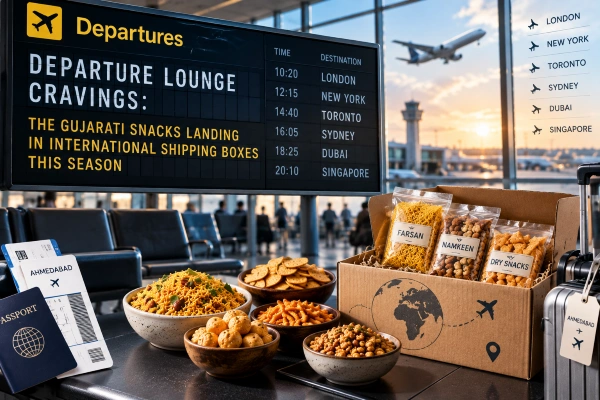
There’s a specific kind of shopping list that starts forming a few weeks before a flight back to the US, UK, Canada, or the Gulf — not clothes or gifts, but a very particular set of namkeen names scribbled down after a WhatsApp call with someone still in Gujarat. Increasingly, though, that list isn’t waiting for a flight at all. It’s going straight into an international order, shipped directly rather than carried back in a suitcase.

Looking at what’s actually landing in these international shipments — rather than assuming it’s just “whatever’s popular in India” — reveals a pattern shaped as much by shelf life and travel practicality as by taste alone.

Sev Orders Abroad Are Getting More Specific

A few years ago, an international order might have simply said “sev” and left it at that. That’s no longer really the case. Buyers abroad are now requesting specific variants by name, often because they’ve had a chance to try more than one and have settled on a clear favourite.

The Garlic Sev has become a particularly frequent international request, likely because its stronger, more distinct flavour holds up well even after weeks in transit, unlike more delicate variants that can lose some character over a long shipping window. The Jini Tikhi Sev shows up often too, usually from buyers who’ve specifically mentioned missing the sharper, spicier bite that’s harder to replicate with locally available Indian sev abroad. Meanwhile, the Palak Fudina Sev is gaining traction among households abroad trying to introduce their India-born parents’ generation of flavours to children who’ve grown up eating milder food overseas.

The dependable trio — Aloo Sev, Aloo Mari Sev, and Aloo Palakh Sev — still anchors most international orders, largely because they’re familiar enough to appeal across generations within the same household abroad.

Ganthiya Requests Are Increasingly Specific by Name

International orders for ganthiya have moved well past generic requests too. The Bhavnagari Ganthiya remains the most requested by far, often tied directly to recreating a Sunday jalebi-ganthiya breakfast that doesn’t quite feel the same with a generic substitute found in overseas Indian grocery stores. The Athanu Bhavnagari Ganthiya has also started appearing more frequently in repeat international orders, generally from buyers who’ve already tried the classic version and specifically gone looking for the tangier one afterward.

Shelf-Stable Regional Specialties Are Traveling Further Than Expected

Some items that might seem too regional to travel well internationally are turning up more often than expected. The Baroda No Lilo Chevdo is a good example — its herby, green-chilli flavour doesn’t fade much over a long shipping period, making it a solid choice for buyers who want something that tastes distinctly homemade rather than mass-produced. The Bardoli Na Dry Patra fits a similar pattern, appealing to households abroad who loved fresh patra back home but have no easy way to recreate it in a kitchen overseas — the dry, shelf-stable format solves that gap directly.

The Bhadran Moong is also seeing steady international demand, often from buyers specifically looking for a lighter, protein-forward snack that fits better with the more health-conscious eating habits many adopt after moving abroad.

Vacuum-Packed Bhakhri Is the Clear Winner for International Orders

If there’s one format that’s disproportionately favoured in international shipments compared to domestic orders, it’s vacuum-packed bhakhri. Given how much longer international shipping takes compared to a delivery within India, the difference in shelf life between regular and vacuum-sealed packaging becomes far more noticeable. The Bhakhri Jeera Vacuum and Bhakhri Mari Vacuum consistently outperform their standard counterparts in international orders for exactly this reason, while the regular Bhakhri Jeera, Bhakhri Mari, and Bhakhri Methi still get requested by buyers closer to a shipping route or those planning to consume them sooner after arrival.

Bhel: The One Item Ordered Purely on Impulse

Unlike almost everything else on this list, the Bhel doesn’t fit a neat travel-practicality pattern — it’s typically added to international orders somewhat spontaneously, usually by someone craving a taste of Indian street-style chaat that’s genuinely difficult to recreate with locally sourced ingredients abroad.

Why Understanding This Pattern Matters for International Buyers

Ordering Gujarati snacks internationally isn’t quite the same exercise as picking from a shelf in Ahmedabad. Shelf life, packaging format, and how well a flavour profile holds up over a longer transit window all play a bigger role than they would for a domestic buyer. Recognising which formats and variants tend to travel and hold up best — vacuum-packed bhakhri, robustly flavoured sev, and naturally shelf-stable items like chevdo and dry patra — helps international buyers get closer to the fresh, authentic experience they’re actually looking for.

KQB Food, based in Ahmedabad, ships this entire range internationally, sticking to the same traditional recipes that have made these snacks reliable repeat orders both within India and abroad. The full selection is available through their namkeen catalogue.

What’s landing in international shipping boxes right now tells a slightly different story than what’s simply “popular” in Ahmedabad — it’s shaped as much by what survives a long journey well as by taste alone. From increasingly specific sev requests to the clear preference for vacuum-packed bhakhri, these patterns reflect a diaspora that’s gotten more particular, not less, about getting the real thing. Explore the full range and place an order through KQB Food wherever you’re snacking from.

Frequently Asked Questions

1. Why do vacuum-packed bhakhri varieties perform better in international orders?

Vacuum sealing helps preserve freshness and crunch over the longer transit times involved in international shipping, unlike standard packaging.

2. Which sev variety travels best for international orders?

Garlic Sev and other robustly flavoured varieties tend to hold their taste and texture well over long shipping periods compared to more delicate options.

3. Are regional specialties like chevdo and dry patra suitable for international shipping?

Yes, naturally shelf-stable items like Baroda No Lilo Chevdo and Bardoli Na Dry Patra tend to travel well internationally without significant loss of flavour.

4. Why do international buyers request specific ganthiya varieties by name?

Many buyers abroad have already tried multiple varieties and developed a clear preference, often between the classic Bhavnagari Ganthiya and the tangier Athanu version.

5. Is bhel a common item in international Gujarati snack orders? 

Bhel tends to be ordered on impulse by those craving Indian street-style chaat, rather than as part of a routine or planned international order.

6. Where can I order authentic Gujarati snacks for international delivery? 

KQB Food, based in Ahmedabad, ships its full namkeen range internationally, available through their product catalogue.
Every household has a shelf that never quite empties out the same way twice — some namkeen tins get refilled the moment they’re scraped clean, while others sit half-finished for weeks. Track that pattern across enough Ahmedabad kitchens, and a fairly consistent shortlist starts to emerge: the snacks that don’t just get bought once out of curiosity, but keep landing back in the cart order after order.

This isn’t a list of what’s technically “popular” in some abstract sense — it’s a look at what’s actually earning repeat orders right now, and why each one keeps making the cut.

The Sev Family Is Splitting Into Micro-Preferences

Sev used to be a fairly simple choice — plain besan or aloo, take it or leave it. That’s changed noticeably. Households are increasingly picking a specific sev variant based on mood or occasion rather than defaulting to whichever tin is already open, and that shift shows up clearly in reorder patterns.

The Jini Tikhi Sev has found a steady niche among people who specifically want something thin, sharp, and spicy rather than the softer, milder classics — it’s become the go-to for anyone topping a chaat or wanting a stronger bite in a mixture. The Garlic Sev has quietly built its own following too, particularly among buyers who’ve moved away from plain sev entirely in favour of something with a more pronounced, savoury edge. On the lighter end, the Palak Fudina Sev is showing up more often in households actively looking for something that feels a little fresher, thanks to the spinach and mint base cutting through the usual besan richness.

The everyday staples haven’t lost ground either — the Aloo Sev, Aloo Mari Sev, and Aloo Palakh Sev remain steady repeat purchases, largely because they work across age groups in the same household without needing a separate “adult” and “kid” tin.

Ganthiya Keeps Splitting Into Two Camps

Reorder data on ganthiya tends to split cleanly into two groups: those who stick to the classic, and those who’ve moved on to the tangier version. The Bhavnagari Ganthiya remains the anchor purchase for most households, particularly around weekends when jalebi-ganthiya breakfasts are still very much a routine. But the Athanu Bhavnagari Ganthiya has been gaining ground steadily among buyers who’ve developed a taste for its pickle-forward spicing, often ordering it specifically instead of, rather than alongside, the classic version.

Chevdo, Patra, and Moong Are Moving From Occasional to Regular

A few items that used to be occasional, festival-adjacent purchases have shifted into regular reorder territory. The Baroda No Lilo Chevdo is a clear example — once mostly associated with visits to or from Vadodara, it’s now a standing reorder for households that have simply gotten used to having it around. The Bardoli Na Dry Patra has followed a similar path, moving from “interesting to try once” to a repeat pick for anyone who’s come to prefer its dry, shelf-stable format over making fresh patra at home.

The Bhadran Moong shows a slightly different pattern — its repeat purchases are driven less by taste discovery and more by households actively trying to build a lighter, protein-leaning snack option into their weekly rotation, alongside the heavier fried classics.

Bhakhri’s Vacuum-Packed Versions Are Outpacing the Regular Ones

Among the more telling shifts is what’s happening with bhakhri. The core flavours — Bhakhri Jeera, Bhakhri Mari, and Bhakhri Methi — remain steady, but a growing share of repeat orders are specifically for the vacuum-packed versions, like Bhakhri Jeera Vacuum and Bhakhri Mari Vacuum. This lines up with how bhakhri is actually being used now — less as a pantry staple eaten at home, and more as something packed for train journeys, tiffins, and gifting, where the extra shelf life of a sealed pack genuinely matters.

Bhel Is the Wildcard Reorder

Unlike the rest of this list, the Bhel doesn’t follow a predictable pattern tied to season or occasion — it gets reordered impulsively, usually right after someone’s had a craving for street-style chaat and doesn’t want to deal with assembling it from separate ingredients. Its repeat-purchase behaviour looks more like a snack food than a namkeen, which is part of why it keeps showing up on carts that otherwise look nothing alike.

What Ties These Reorders Together

Looking across this list, the common thread isn’t really flavour or price — it’s that each of these items has found a specific, recurring use case in someone’s routine, whether that’s a weekend breakfast ritual, a travel snack, a lighter alternative, or an impulsive craving fix. That’s generally a better signal of genuine demand than a one-time bestseller list, since it reflects what people actually keep coming back for rather than what they tried once.

KQB Food carries this entire range, made using the same traditional recipes that have kept these items in steady rotation across Ahmedabad households. You can browse the full namkeen selection through their product catalogue.
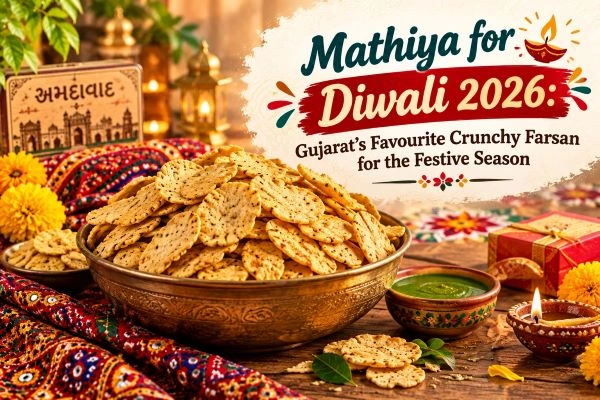
Reorder patterns tend to say more about a snack’s actual staying power than any single sales spike ever could. From the growing split within the sev family to bhakhri’s shift toward vacuum-packed formats, what Ahmedabad households keep restocking says a lot about how their everyday snacking habits are quietly evolving. Explore the full range and see which of these has already earned a permanent spot in your own rotation at KQB Food.

Frequently Asked Questions

1. Why are vacuum-packed bhakhri varieties becoming more popular than regular ones?

Vacuum-packed bhakhri holds its crunch and freshness longer, making it better suited for travel, tiffins, and gifting compared to regular packaging.

2. What’s driving demand for tangier ganthiya options like Athanu Bhavnagari Ganthiya? 

Buyers who’ve developed a preference for pickle-style, spiced flavours are increasingly choosing tangier ganthiya variants over the classic version.

3. Is chevdo still considered a regional specialty or an everyday snack now?

While chevdo varieties like Baroda No Lilo Chevdo originated as regional specialties, they’ve increasingly become regular household staples rather than occasional purchases.

4. Why do some households prefer moong-based snacks over fried besan options?

Moong-based snacks like Bhadran Moong offer a lighter, protein-forward alternative for households balancing traditional flavours with lighter snacking habits.

5. What makes bhel different from typical reordered namkeen?

Bhel tends to be purchased impulsively based on cravings rather than as part of a routine restocking pattern, unlike more habitual namkeen purchases.

6. Where can I order these trending Gujarati snacks online?

The full range, including sev varieties, ganthiya, chevdo, bhakhri, and bhel, is available through KQB Food’s namkeen collection.

Ahmedabad has a word for a very specific kind of eating that doesn’t happen at mealtime, isn’t tied to hunger, and doesn’t need a reason: timepass. It’s what happens on a terrace after dinner, at a bus stop while waiting for a friend who’s running late, during a power cut when the TV’s off and there’s nothing to do but talk, or scrolling through a phone on a lazy Sunday afternoon with absolutely no agenda. The food that fits into these moments is its own category entirely — light, crunchy, instantly satisfying, and gone from the packet before you’ve even noticed you finished it.

This is a look at that specific habit — not as a snack list, but as the small, empty stretches of time it actually fills — along with where to get the real thing online.

The Five-Minute Window

Timepass snacking rarely lasts long. It fills the exact stretch between one thing ending and another beginning — the ad break, the wait for the kettle to boil, the ten minutes before a video call starts. Because the window is so short, the snack itself has to deliver everything immediately: no assembly, no side dish, no waiting. Just tear, crunch, repeat.

This is exactly why fryums and rings have held their place in Ahmedabad’s snacking habits for so long. The Appu Fryums hit that instant, airy crunch that disappears from the bowl faster than most people realise, while the Manchurian Ring and Tomato Ring bring a sharper, more distinct flavour hit for anyone who wants their five minutes of timepass to actually taste like something memorable. On warmer evenings, the Pudina Rings add a cooling mint edge that somehow makes doing absolutely nothing feel slightly more refreshing.

The Longer Stretch

Not all timepass is five minutes, though. Some of it is an hour of waiting at a railway station, a long autorickshaw ride across the city, or an entire lazy afternoon with nowhere particular to be. This calls for something with a bit more chew and staying power — snacks that can be picked at slowly rather than finished in one go.

The Soya Stick and Tomato Stick are built exactly for this — firmer, more filling, and satisfying enough to stretch across a longer stretch of idle time without feeling like a full meal. The Soya Chips offer a flatter, thinner alternative for the same kind of extended, unhurried snacking, especially popular during long study sessions or slow work-from-home afternoons.

The Corner Everyone Secretly Prefers

Ask around, and most people will admit that the flavoured, cheesy end of the snack shelf is where their hand actually goes first, even if they claim to prefer something “healthier.” The Cheese Ball and both Cheese Popcorn and Cheese Popcorn options have become the default choice for movie nights at home, weekend get-togethers, and pretty much any occasion that calls for a shared bowl in the middle of the table. For those who prefer the original, uncomplicated version, the Classic Salted Popcorn still holds its own, proving that not every timepass craving needs a bold flavour twist. And when someone specifically asks for a snack by name rather than picking whatever’s closest, it’s almost always the Kurkure that gets requested first.

Timepass Is Rarely a Solo Activity

There’s also a social side to this that often gets overlooked. A lot of timepass snacking happens in twos and threes — friends catching up on a terrace, cousins during a power cut, colleagues stretching a tea break a few extra minutes. In these settings, the snack becomes less about individual taste and more about having enough variety on hand that everyone reaching into the same bowl finds something they actually like.

This is where keeping a small mix on hand pays off more than committing to just one packet. A shared bowl with a bit of Kurkure, a handful of cheese balls, and a scoop of classic salted popcorn tends to disappear faster and generate more conversation than any single snack on its own — proof that even something as small as timepass snacking has its own unspoken social etiquette in Ahmedabad.

Why Timepass Snacking Deserves Better Than Whatever’s Nearby

Most people default to whatever snack happens to be within arm’s reach during these idle moments, which usually means settling for something average simply because it was convenient. But since timepass eating happens so often — arguably more frequently than any planned meal — it’s worth stocking a proper rotation of options rather than relying on whatever’s left in the cupboard.

KQB Food, made right here in Ahmedabad, brings together this entire range of fryums, rings, sticks, popcorn, and more in one place, so restocking for the next round of timepass doesn’t mean settling for less than the real thing. Browse the full range and order directly through KQB Food’s catalogue.

Timepass isn’t really about the snack — it’s about the moment it fills: the wait, the pause, the stretch of nothing-in-particular that makes up a surprising amount of everyday life in Ahmedabad. Whether it’s a quick five-minute fryum fix or a slow afternoon with a bag of soya sticks, having the right options on hand turns idle time into something genuinely enjoyable. Order the complete timepass range from KQB Food and keep those in-between moments a little more interesting.

Frequently Asked Questions

1. What does “timepass” mean in the context of snacking?

Timepass refers to eating done purely to fill idle or waiting periods, unrelated to regular mealtimes, and typically involves light, crunchy, instantly satisfying snacks.

2. What’s the difference between fryums, rings, and sticks?

Fryums are light, airy, and quick to finish, rings offer a bolder flavour hit in a similar light format, while sticks are firmer and more filling, suited for longer snacking stretches.

3. Which timepass snacks work best for movie nights or group gatherings?

Cheese-flavoured options like cheese balls and cheese popcorn tend to be the most popular choices for shared snacking during movie nights or casual get-togethers.

4. Are there lighter, less heavily flavoured timepass snack options available?

Yes, classic salted popcorn offers a simpler, less intense flavour profile for those who prefer a more traditional snacking option.

5. Why do people prefer ordering timepass snacks in bulk rather than one at a time?

Since timepass eating happens frequently throughout the week, keeping a rotation of different snacks on hand avoids settling for whatever’s left over or convenient at the moment.

6. Where can I order authentic Ahmedabad-made timepass snacks online?

The complete range, including fryums, rings, sticks, and popcorn, is available for order through KQB Food’s product catalogue.

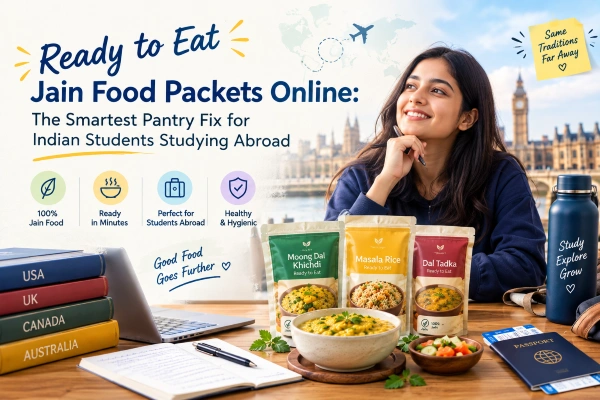
Move a Jain student into a university dorm anywhere outside India, and within the first month a very specific pattern shows up: skipped meals, endless bowls of plain rice or pasta, and a growing pile of instant noodles that are “safe” mostly because there’s nothing to check for onion or garlic in the first place. Between shared kitchens, tight budgets, unpredictable class schedules, and zero access to Jain-specific ingredients, sticking to a proper Jain diet while studying abroad is one of the more underrated struggles international students deal with.

This is exactly why searches for ready-to-eat Jain food packets online spike heavily during exam season and right after students land abroad for the first time—it’s less about convenience and more about having one reliable way to eat properly without a fully equipped kitchen, extra grocery runs, or hours to spare.

Why Dorm Life Makes Jain Eating Especially Hard

Most student housing comes with limited cooking equipment, shared fridge space, and kitchens that are busiest exactly when everyone wants to cook — right before or after classes. For a Jain student, that already tight window gets tighter, since cooking a proper Jain meal from scratch means sourcing asafoetida, the right spice ratios, and vegetables that exclude anything root-based, none of which are guaranteed to be available at a regular international grocery store near campus.

Add exam weeks, part-time jobs, and irregular schedules into the mix, and the realistic outcome for a lot of Jain students isn’t “cook a full meal every day”—it”‘s “eat something that doesn’t compromise on diet, quickly, on a day when there’s genuinely no time to cook.”

What to Look for When Ordering Jain Food as a Student Abroad

Budget and shelf life matter more for students than for most other buyers. Vacuum-sealed or dehydrated packets that don’t need refrigeration are ideal for shared dorm fridges with limited space, and a longer shelf life means fewer, larger orders instead of constant restocking. It’s also worth checking preparation time specifically—between classes, part-time work, and assignments, a meal that needs a 20-minute cook isn’t realistic on most weekdays, while something ready in under 10 minutes actually gets used.

The Jain Ready-to-Eat Range That Fits a Student Schedule

For mornings before an early lecture, the Jain Poha and Jain Upma are about as practical as breakfast gets—quick to prepare, light enough to eat before class, and familiar enough to feel like a proper meal rather than another packaged snack grabbed on the way out.

For dinners squeezed between library sessions or part-time shifts, the Jain Paneer Butter Masala delivers a genuinely satisfying, restaurant-style meal without needing a fully stocked kitchen — just a pan or hot water and a few minutes. The Jain Palak Paneer works as a slightly lighter alternative for students trying to balance hostel food fatigue with actual nutrition, especially useful during exam weeks when proper meals tend to get skipped altogether.

And for the specific craving that hits almost every Indian student abroad at some point, the Jain Pav Bhaji solves a problem most students assume has no solution overseas—a properly made, onion-and-potato-free version of a dish that’s otherwise nearly impossible to find outside India, let alone in Jain-compliant form.

Making These Work in a Shared Kitchen

Most of this range is built for minimal equipment—a single pan, a kettle, or even just hot water for boil-in-pouch preparation, which matters when shared kitchen access is limited or inconvenient. Keeping a small stock of Jain Poha and Upma for mornings, alongside a couple of Paneer Butter Masala or Pav Bhaji packets for busier evenings, covers a realistic week without needing daily access to a full kitchen setup or a long prep window between classes.

Why This Matters Beyond Just Convenience

For a lot of Jain students, this isn’t only about food — it’s one of the few consistent threads connecting them to home during an otherwise disorienting first year abroad. Skipping meals or constantly compromising on diet tends to add up quietly over a semester, showing up as fatigue, poor concentration during exams, or simply a growing sense of being unable to eat “normally” the way they did at home. Having a reliable, properly made Jain option removes that friction, letting food be one less thing to manage on top of an already demanding academic schedule.

Ordering for International Student Delivery

KQB Food, based in Ahmedabad, ships its Jain-friendly range internationally in vacuum-sealed, shelf-stable packaging built to handle longer transit times—a practical fit for students who’d rather place one larger order per semester than repeatedly hunt for Jain ingredients locally. The full range, including poha, upma, paneer dishes, and pav bhaji, is available on the Dehydrated & Ready-to-Eat Food category page, alongside additional Jain dal and khichdi options worth adding to a semester-long order.

For Jain students abroad, the search for ready-to-eat Jain food packets online usually comes down to a simple need—eating properly without a full kitchen, a big grocery budget, or hours of free time between classes. With a dedicated range covering breakfast, comfort-food dinners, and even a Jain-friendly pav bhaji fix, ordering from an Ahmedabad-based source like KQB Food means one less thing to worry about during an already demanding academic year.

Frequently Asked Questions

1. Why is it hard for Jain students to eat properly while studying abroad? 

Limited kitchen access, tight budgets, unpredictable schedules, and the unavailability of Jain-specific ingredients like asafoetida make daily Jain cooking difficult in most student housing abroad.

2. Can ready-to-eat Jain food packets be prepared in a shared dorm kitchen?

Yes, most are designed for minimal equipment, needing only a pan, kettle, or hot water for boil-in-pouch preparation, making them suitable for shared or limited kitchen setups.

3. How long do vacuum-sealed Jain ready-to-eat packets last, and are they good for bulk student orders?

Vacuum-sealed, dehydrated packets typically have a considerably longer shelf life than fresh food, making them practical for students to order in bulk once per semester rather than restocking frequently.

4. Is Jain pav bhaji available in ready-to-eat form for students abroad?

Yes, a properly made Jain pav bhaji, prepared without onion or potato, is available as a ready-to-eat packet, addressing a dish that’s otherwise very hard to find abroad.

5. What are the quickest Jain ready-to-eat options for busy exam weeks?

Jain Poha and Jain Upma are the fastest to prepare, making them practical breakfast or light-meal options when time is limited during exams.

6. Where can international students order authentic Jain ready-to-eat food packets online?

KQB Food’s Jain range, including paneer dishes, pav bhaji, poha, and upma, ships internationally and is available through their ready-to-eat food collection.

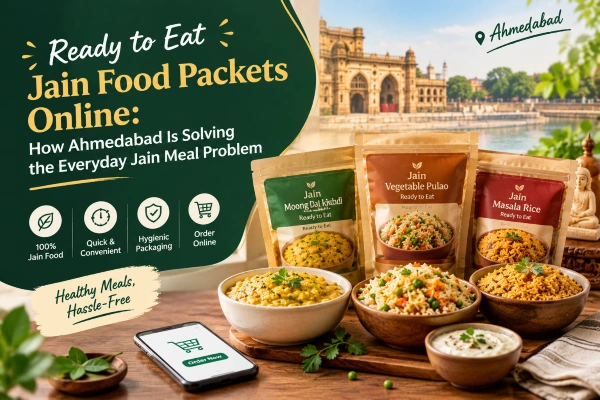
Anyone following a strict Jain diet knows the specific frustration of eating out — scanning menus for anything without onion, garlic, or root vegetables, only to end up ordering the same two or three “safe” dishes every single time. It’s a problem that doesn’t go away at home either, especially on days when there’s no time to cook a full Jain meal from scratch. This is exactly the gap that searches for ready to eat Jain food packets online are trying to solve, and Ahmedabad — home to one of India’s largest and most food-conscious Jain communities — has quietly become the place where this problem is being solved properly.

This guide looks at what actually makes a ready-to-eat Jain packet worth ordering, and which specific products are worth adding to your pantry.

Why “Ready to Eat” Is Different for Jain Food

Ready-to-eat food already has a mixed reputation — often too salty, too processed, or simply not close enough to home-cooked taste to justify the convenience. That gap gets even wider for Jain food, because most mainstream ready-to-eat brands either skip Jain options entirely or make half-hearted attempts that use onion powder or garlic-derived flavouring under generic labels.

A genuinely good Jain ready-to-eat product has to solve two problems at once: staying completely free of onion, garlic, and root vegetables like potato in dishes that traditionally rely on them for flavour and texture, while still tasting close enough to the original that it doesn’t feel like a compromise. That second part is where most attempts fall short — and it’s the specific reason demand for ready to eat Jain food packets online keeps growing, since people are actively looking for brands that get this right rather than settling for whatever’s available locally.

What to Look for Before Ordering Jain Ready-to-Eat Packets Online

Before adding anything to cart, a few checks are worth making. First, confirm the product is explicitly labelled Jain, not just “vegetarian,” since the two are not the same thing. Second, look at how the flavour is built without onion and garlic — good Jain cooking typically compensates with ingredients like asafoetida (hing), ginger, and specific spice ratios rather than skipping flavour altogether. Third, check the packaging format; vacuum-sealed, shelf-stable pouches with clear rehydration or heating instructions tend to hold up far better than simple sealed trays.

The Jain Ready-to-Eat Range Worth Ordering

KQB Food’s Jain range covers both comfort-food staples and richer restaurant-style dishes, all made strictly without onion, garlic, or root vegetables.

For a quick breakfast or evening snack, the Jain Poha and Jain Upma are two of the most practical options in the entire category. Both are dishes that Jain households already eat regularly, but making them fresh every single morning isn’t always realistic — having a ready-to-eat version means the same familiar breakfast is available in minutes, without hunting for onion-free versions of spice mixes.

On the richer side, the Jain Paneer Butter Masala recreates the classic North Indian restaurant favourite using a tomato-cashew base built up without onion or garlic, relying instead on the right balance of spice and cream to get the depth right. The Jain Palak Paneer follows the same principle, using a properly seasoned spinach gravy that doesn’t lean on onion for its base flavour, which is where many home attempts at Jain palak paneer tend to fall flat.

For anyone who’s had to skip street food specifically because of pav bhaji’s typically onion-heavy base, the Jain Pav Bhaji is worth calling out on its own. Pav bhaji is one of the hardest dishes to convincingly “Jain-ify” since so much of its flavour traditionally comes from a well-cooked onion-tomato base — getting this right, without potato either, is a genuine test of a brand’s Jain cooking expertise.

Who’s Actually Searching for This

The demand behind ready to eat Jain food packets online isn’t limited to one type of buyer. Jain students living away from home for college, working professionals in cities without easy access to Jain-specific restaurants, elderly parents who want quick, familiar meals without daily cooking, and even non-Jain households looking to reduce onion-garlic intake for personal or health reasons all show up in this search category. Ahmedabad, with its dense Jain population and strong food manufacturing base, has ended up as a natural hub for brands solving this specific need well.

How to Prepare These for the Best Result

Most ready-to-eat Jain packets, including this range, are designed for quick heating — either a short boil-in-pouch method or a stovetop warm-up after opening. Pairing something like Jain Paneer Butter Masala or Jain Palak Paneer with fresh rotis, and Jain Pav Bhaji with toasted pav, closes most of the remaining gap between “ready-to-eat” and “home-cooked,” while poha and upma need little more than a quick reheat and a garnish of fresh coriander or lemon if available.

Ordering the Full Jain Range Online

KQB Food makes its entire Jain-friendly range available for online ordering directly from Ahmedabad, covering everything from quick breakfasts like poha and upma to full dinner options like paneer butter masala, palak paneer, and pav bhaji. You can browse the complete lineup, including additional Jain dal and khichdi options, on the Dehydrated & Ready-to-Eat Food category page.

The search for ready to eat Jain food packets online usually comes from a very specific, recurring problem — wanting a proper meal without spending time hunting for onion-and-garlic-free options every single time. With a dedicated range covering breakfast, paneer dishes, and even Jain-friendly pav bhaji, ordering directly from an Ahmedabad-based maker like KQB Food means that problem gets solved once, rather than every time hunger strikes.

Frequently Asked Questions

1. What makes food “Jain” rather than just vegetarian?

Jain food excludes onion, garlic, and root or underground vegetables like potato, in addition to meat and eggs, following dietary principles rooted in minimising harm to living organisms.

2. Are ready-to-eat Jain food packets healthy?

Quality varies by brand, but well-made Jain ready-to-eat packets that avoid excessive preservatives and use proper Jain-compliant ingredients can be a reasonably balanced option for quick meals.

3. How is flavour maintained in Jain food without onion and garlic?

Good Jain cooking typically relies on asafoetida (hing), ginger, and carefully balanced spice combinations to replicate depth of flavour that onion and garlic would otherwise provide.

4. Can ready-to-eat Jain pav bhaji really taste authentic without onion or potato?

It depends heavily on preparation technique — a well-made version compensates with a thicker tomato-based mix and the right spice blend, though it will differ slightly from traditional onion-potato pav bhaji.

5. Are Jain poha and upma available as ready-to-eat options?

Yes, ready-to-eat Jain poha and upma are available for quick breakfast or snack preparation without needing to source onion-free spice mixes separately.

6. Where can I order authentic ready-to-eat Jain food packets online in India?

KQB Food, based in Ahmedabad, offers a full range of Jain ready-to-eat meals, available through their dehydrated and ready-to-eat food collection.

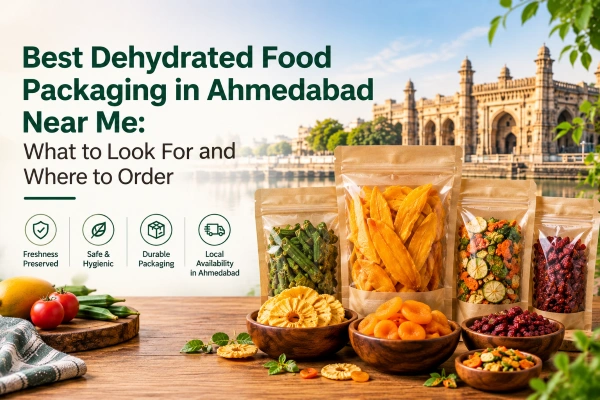
Type “best dehydrated food packaging Ahmedabad near me” into Google and you’ll notice something quickly—most results either talk about industrial packaging machinery or generic freeze-dried snack brands with no real connection to the city. If you’re actually looking for well-packaged, ready-to-eat dehydrated food made in Ahmedabad — the kind you can stock in a pantry, carry on a trek, or keep on hand for busy weeknights — the search gets a lot less specific than it should be.

This guide breaks down what actually makes dehydrated food packaging good, why it matters more than people realise, and where to find a genuinely local, Ahmedabad-based option that gets both the food and the packaging right.

What Makes Dehydrated Food Packaging “Good” in the First Place

Dehydrated and freeze-dried food lives or dies on its packaging. Unlike regular packaged snacks, dehydrated meals depend entirely on staying moisture-free to retain both their texture and their shelf life — a poorly sealed pack can turn a perfectly good dal khichdi into something clumpy or stale within weeks, regardless of how well the food itself was prepared.

Good dehydrated food packaging typically covers a few non-negotiables: airtight, multi-layer pouches that block moisture and light, proper vacuum sealing to remove excess air, portion sizing that matches how the food will actually be reconstituted, and clear instructions for rehydration since most of these products are meant to be prepared quickly with hot water. When any one of these is missing, the “shelf-stable” promise on the label doesn’t really hold up in practice.

Why This Matters More in a City Like Ahmedabad

Ahmedabad’s climate — long stretches of heat followed by humid monsoon months — makes packaging quality especially important for anything meant to sit in a pantry for weeks or months. Food that’s dehydrated but poorly packaged doesn’t just lose freshness faster here; it’s also more prone to picking up moisture during the monsoon, which defeats the entire purpose of choosing a dehydrated product in the first place.

This is also why searching specifically for a local Ahmedabad-based source matters, rather than ordering from a distant supplier whose packaging may not have been tested against local storage and transit conditions.

Ready-to-Eat Dehydrated Meals Worth Knowing About

Beyond just packaging, the actual value of good dehydrated food comes down to how close it gets to home-cooked taste once rehydrated. KQB Food’s ready-to-eat range covers a solid spread of everyday Indian meals designed for exactly this — quick preparation without sacrificing flavour.

For comfort-food basics, there’s the Dal Chawal and Dal Khichdi Ready to Eat, both built around the kind of simple, digestible meal most Indian households turn to on a tiring day. The Gujarati Dal Ready to Eat brings the specific sweet-tangy profile of Gujarati dal into a shelf-stable format, which is genuinely hard to find pre-made outside the region.

For richer options, the Dal Makhani Ready to Eat and its Jain counterpart, the Jain Dal Makhani Ready to Eat and Jain Dal Makhani, cater to different dietary preferences without dropping the dish’s signature creaminess. Similarly, the Jain Khichdi Kadhi and Jain Masala Khichdi Kadhi give Jain households a proper khichdi-kadhi combination without onion or garlic, which is often difficult to find in ready-to-eat form.

The range extends into North Indian favourites too, with Jain Paneer Butter Masala and a second variant, Jain Paneer Butter Masala, alongside Jain Paneer Lababdar, Jain Palak Paneer and its alternate version Jain Palak Paneer, and Jain Paneer Bhurji. Rounding out the street-food side, there’s Jain Pav Bhaji and a second Jain Pav Bhaji option — a genuinely useful find for Jain families who otherwise have to skip pav bhaji entirely when eating out.

Who Actually Needs Well-Packaged Dehydrated Food

It’s easy to assume dehydrated food is only for trekkers and travellers, but the real demand in a city like Ahmedabad is broader than that. Working professionals who want a proper meal ready in minutes, students living away from home, elderly parents who need quick, digestible food without daily cooking effort, and families stocking up before travel or unpredictable weeks all rely on this category more than people expect.

Jain households in particular benefit from a dedicated ready-to-eat range, since finding onion-and-garlic-free packaged meals — especially in richer preparations like paneer butter masala or pav bhaji — is far harder than finding standard versions.

What to Check Before You Buy Locally

If you’re specifically searching for “dehydrated food packaging near me” in Ahmedabad, a few quick checks help separate genuinely good options from ones riding on the freeze-dried trend without the packaging quality to back it up: look for vacuum-sealed or multi-layer pouches rather than simple plastic bags, check that the pack states a realistic shelf life rather than a vague “long-lasting” claim, and confirm rehydration instructions are clear and specific rather than generic.

KQB Food operates directly out of Ahmedabad and pairs its dehydrated and ready-to-eat range with dedicated vacuum packaging expertise, which is exactly the combination worth looking for when the search is about packaging quality as much as the food itself. The full lineup, including all the dal, khichdi, and paneer options above, is available on the Dehydrated Food (Freeze-Dried Food) category page.

“Best dehydrated food packaging near me” isn’t really a question about finding the fanciest pouch design — it’s about finding food that stays genuinely fresh in Ahmedabad’s climate, rehydrates properly, and actually tastes like something homemade rather than a compromise. Between a wide Jain-friendly ready-to-eat range and packaging built for local storage conditions, KQB Food covers both sides of that search. Explore the complete dehydrated food range and see which ready-to-eat meal earns a permanent spot in your pantry.

Frequently Asked Questions

1. What makes dehydrated food packaging different from regular food packaging?

Dehydrated food packaging relies on airtight, moisture-blocking, multi-layer pouches and vacuum sealing to preserve texture and shelf life, since even small amounts of moisture can spoil the product.

2. Why does climate matter for dehydrated food storage in Ahmedabad?

Ahmedabad’s heat and monsoon humidity can compromise poorly sealed packaging faster than in drier or more temperate regions, making proper vacuum and moisture-barrier packaging essential.

3. Are ready-to-eat dehydrated meals suitable for Jain diets?

Yes, several ready-to-eat options, including Jain dal makhani, Jain khichdi kadhi, and Jain paneer preparations, are made without onion and garlic to suit Jain dietary requirements.

4. How long do vacuum-packed dehydrated meals typically last?

Shelf life varies by product, but properly vacuum-sealed dehydrated meals generally last significantly longer than fresh food when stored in a cool, dry place — check the specific product packaging for exact duration.

5. Who typically buys ready-to-eat dehydrated food?

Working professionals, students, travellers, elderly individuals living alone, and families stocking up for busy or unpredictable weeks are among the most common buyers.

6. Where can I find well-packaged dehydrated and ready-to-eat food in Ahmedabad?

KQB Food, based in Ahmedabad, offers a full range of dehydrated and ready-to-eat meals paired with dedicated vacuum packaging, available on their dehydrated food category page.

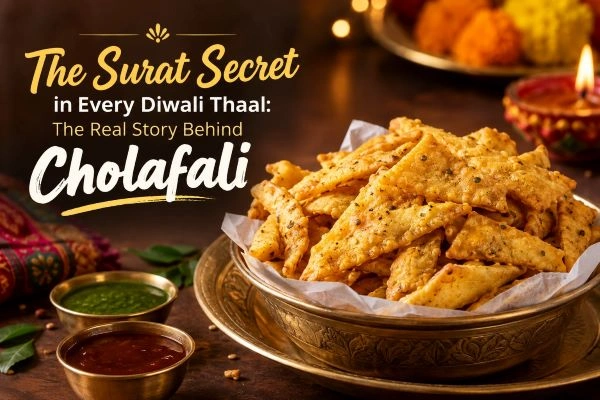
Most people who eat cholafali every Diwali have never actually asked where it came from — it just appears on the farsan thaal, gets devoured in minutes, and shows up again the following year like clockwork. But cholafali has a specific, traceable origin story, and understanding it explains a lot about why this particular snack became a festival fixture rather than just another item in Gujarat’s enormous namkeen catalogue.

With Diwali 2026 arriving on Sunday, November 8, and the festivities running from Dhanteras on November 6 through Bhai Dooj on November 10, this is a good moment to look at cholafali not just as something to order, but as a snack with a genuine craft behind it — one that’s worth understanding before it lands on your farsan plate this year.

Where Cholafali Actually Comes From

Cholafali is widely credited to Surat, a city that has historically punched above its weight when it comes to Gujarati food innovation — the same city that gave Gujarat locho, ghari, and undhiyu as we know it today. Surti cooks are known for taking relatively simple ingredients and applying an almost obsessive level of technique to them, and cholafali is a textbook example of that approach.

Unlike ganthiya or sev, which rely mainly on the right spice mix and frying temperature, cholafali depends heavily on how thin the dough sheets are rolled before frying. Traditionally, skilled cholafali makers in Surat could roll the urad-moong dal dough thin enough that it would puff up into an almost transparent, glass-like sheet the moment it hit hot oil — a skill that took years to master and is still considered a mark of quality today. This is why authentic cholafali has such a distinct, delicate texture compared to other fried Gujarati snacks; it’s essentially a technique-driven food, not just a recipe-driven one.

How Cholafali Travelled From Surat to Every Gujarati Home

As Gujarati families moved between cities — Surat to Ahmedabad, Ahmedabad to Vadodara, and eventually across India and abroad — cholafali travelled with them, carried both as a physical gift and as a recipe passed down through households. Over time, it stopped being a “Surti specialty” and became a pan-Gujarati festival staple, particularly for Diwali, when families wanted something that felt a little more special than everyday farsan.

What helped cement its place at Diwali specifically is practical: cholafali doesn’t get made casually on a random Tuesday. Because of the skill and time the thin-rolling technique demands, it has historically been reserved for occasions worth the effort — weddings, Diwali, and other major family gatherings. That association has stuck, which is why cholafali still feels like an “occasion snack” even now, when most Gujarati households buy it ready-made rather than rolling it by hand.

The Flavour That Makes Cholafali Different

What separates cholafali from nearly every other item on a Diwali farsan plate is its layered taste. The base is savoury and mildly earthy from the urad and moong dal, but it’s finished with black salt, coarsely ground black pepper, and a light sugar-lime syrup brushed across the surface — giving it a sweet-tangy-spicy hit that changes with every bite, depending on which part of the sheet you’re eating.

This is a deliberate contrast to the rest of a typical Gujarati Diwali spread, which tends to lean heavily savoury (ganthiya, sev, mathiya) or heavily sweet (mithai). Cholafali sits in between, which is exactly why it doesn’t get skipped even when the plate is already full — it offers something the rest of the thaal doesn’t.

Two Ways to Experience Cholafali This Diwali

KQB Food keeps this traditional Surat-style preparation intact across its cholafali range, giving you two ways to experience the snack depending on preference. The Cholafali follows the classic thin-rolled, lightly fried style — the version closest to what you’d find at an old-school Surat farsan shop, with that signature delicate crunch and balanced sweet-spice finish.

For those who prefer a heartier bite, the Fried Cholafali takes the same base preparation through a deeper fry, resulting in a firmer, more robust crunch that holds up especially well in Diwali gift boxes and during the five days of guest visits when a container might be opened and closed repeatedly.

Why This Origin Story Matters When You’re Buying Cholafali

Knowing where cholafali comes from is more than trivia — it’s actually a useful way to judge quality. Because the entire identity of cholafali rests on how thin and evenly it’s rolled before frying, poorly made versions tend to be thicker, chewier, or unevenly puffed, losing the glass-like crispness that defines the real thing. When you’re ordering online, especially ahead of a busy festival like Diwali, sourcing from a maker that respects that original Surat technique — rather than a generic, mass-produced version — makes a noticeable difference in the final bite.

This is where KQB Food has built its reputation within Gujarat’s namkeen space: sticking to traditional preparation methods across its farsan range rather than cutting corners for scale. You can explore the full selection on the Cholafali category page, or browse the wider Papad/Mathiya section to round out your Diwali farsan order.

Cholafali’s journey from a Surat specialty to a Diwali essential across Gujarat is really a story about craft outlasting convenience — a snack that stuck around specifically because it was harder to make well, not easier. As Diwali 2026 approaches on November 8, that history is worth remembering the next time a plate of cholafali gets passed around your Diwali gathering. Order the authentic version, in both classic and fried styles, from KQB Food and bring a genuine piece of Surti craftsmanship to this year’s farsan thaal.

Frequently Asked Questions

1. Which city is cholafali originally from?

Cholafali is widely credited to Surat, a city known for its intricate, technique-heavy approach to Gujarati snacks and sweets.

2. Why is cholafali associated with special occasions rather than everyday snacking?

Its preparation requires skillfully rolling the dough into extremely thin sheets before frying, a time-consuming technique traditionally reserved for weddings, Diwali, and other major celebrations.

3. What gives cholafali its distinctive taste?

Cholafali is finished with black salt, black pepper, and a light sugar-lime syrup, creating a sweet-tangy-spicy flavour that’s different from most other Gujarati namkeens.

4. How can I tell if cholafali is made using traditional technique? 

Authentic, well-made cholafali is very thin, evenly puffed, and almost glass-like in texture; thicker or unevenly fried versions usually indicate a shortcut in preparation.

5. What’s the difference between regular and fried cholafali?

Regular cholafali has the classic thin, delicate crunch, while fried cholafali goes through a deeper fry for a firmer, heartier bite and slightly sturdier shelf life.

6. Where can I buy authentic, Surat-style cholafali online for Diwali 2026? 

You can order both classic and fried cholafali directly from KQB Food’s Cholafali collection.

Diwali 2026 falls on Sunday, November 8, with the celebrations beginning at Dhanteras on November 6 and running through Bhai Dooj on November 10—five days during which Gujarati kitchens barely stop producing farsan for family, guests, and neighbors dropping by. Among all the snacks that come out during this stretch, mathiya holds a permanent, non-negotiable spot on the plate.

Mathiya is one of those snacks that manages to be both a daily-life staple and a festival essential at the same time. It’s eaten year-round with chai, but during Diwali specifically, it takes on a slightly more special role—made in larger batches, offered to guests first, and often gifted alongside other farsan in Diwali hampers. If your Diwali shopping list doesn’t have mathiya on it yet, here’s why it should, and which varieties are worth trying this year.

What Is Mathiya, Exactly?

Mathiya is a deep-fried Gujarati snack made from gram flour (besan) dough, seasoned with spices, and shaped into small, ridged, cylindrical pieces before frying until golden and crisp. The ridged shape isn’t just decorative—it increases the surface area, giving mathiya its signature crunch and helping it hold onto spice coatings better than smoother snacks.

What makes mathiya particularly popular during Diwali is its versatility. It’s mild enough to be eaten by itself in large quantities but also spiced enough in some variants to double as a flavor-forward snack for guests who want something with more kick than a plain ganthiya or khakhra.

Mathiya Varieties Worth Adding to Your Diwali 2026 Order

One of the reasons mathiya has stayed popular across generations is how well it adapts to different spice preferences within the same family — and this Diwali, that range is worth taking advantage of rather than sticking to just one type.

The Regular Mathiya is the classic starting point — mildly spiced, universally liked, and the version most households grew up eating with their evening chai. For a deeper, crunchier bite, the Fried Regular Mathiya takes the same base recipe further into the fryer, resulting in a firmer, more textured snack that holds up well over the full five days of Diwali guest visits.

For those who like their farsan with a bit more heat, the Green Chilli Mathiya brings a fresh, sharp spice that cuts through the richness of the fried besan, while the Fried Green Chilli Mathiya intensifies both the crunch and the heat for anyone who wants their Diwali snacking to come with a kick. If green chilli alone doesn’t cut it, the Double Chilli Mathiya goes a step further, layering in extra spice for guests who specifically ask for “something spicier” at every Diwali gathering — there’s always at least one.

The Red Chilli Mathiya offers a different kind of heat altogether — a smokier, more robust spiciness compared to the sharper green chilli versions, and a good option for balancing out a mixed farsan platter. Meanwhile, the Green Garlic Mathiya brings a distinctly aromatic, savoury edge that’s become a favourite among those who want their mathiya to taste a little different from the standard festive spread without straying too far from tradition.

For guests managing sugar intake or simply preferring a less sweet-adjacent snack, the Sugarfree Mathiya is a thoughtful addition to any Diwali order — proving that even a traditional festive namkeen can accommodate modern dietary preferences without losing its authentic character.

Why Mathiya Works So Well for Diwali Entertaining

Diwali in Gujarati households is essentially five days of open house — friends, extended family, and neighbours dropping in across Dhanteras, Choti Diwali, Lakshmi Puja, Govardhan Puja, and Bhai Dooj. Mathiya is practical for exactly this kind of continuous entertaining: it’s quick to serve, doesn’t need any preparation, has a long shelf life compared to fresh sweets, and comes in enough spice variations that you can offer something different to each guest without extra effort.

It’s also a reliable choice for Diwali gift boxes. Pairing a few mathiya varieties — say, regular, green chilli, and green garlic — into a single hamper gives recipients a proper taste of Gujarati farsan variety in one gift, rather than a single-flavour box that gets finished (or ignored) quickly.

Serving and Storage Tips

Mathiya is best served at room temperature, straight out of an airtight container, alongside other Diwali farsan like cholafali, ganthiya, and sev. Because it’s fried and relatively low in moisture, it holds its crunch well for the length of the Diwali festivities, provided it’s kept sealed between servings and away from humidity — something to keep in mind if you’re stocking up early for the five-day celebration.

If you’re ordering multiple varieties, it helps to label containers before the guests start arriving on Dhanteras, especially with the spicier options like double chilli and red chilli mathiya, so nothing gets mixed up mid-gathering.

Ordering Mathiya Online for Diwali 2026

With Diwali 2026 just weeks away once the festive shopping season kicks in, ordering mathiya online ahead of time is the easier route compared to navigating crowded farsan shops during peak Diwali week. KQB Food makes all eight mathiya varieties — from the mild regular version to the double chilli and sugarfree options — available through a single order, made using traditional Gujarati recipes rather than mass-market shortcuts.

You can explore the complete range on the Mathiya category page, or browse the wider Papad/Mathiya section for other festive farsan to round out your Diwali order.

Mathiya’s real strength is that it works for absolutely everyone at a Diwali gathering — the guest who wants something mild, the one who wants extra heat, and even the one avoiding sugar. With Diwali 2026 falling on November 8 and five days of visitors to plan for, stocking up on a mix of mathiya varieties ahead of time is one of the simplest ways to make sure your farsan thaal is ready for whoever walks through the door. Order the full range from KQB Food and keep the Diwali snacking sorted this year.

Frequently Asked Questions

1. What is mathiya made from?

Mathiya is made from gram flour (besan) dough, seasoned with spices and shaped into small ridged, cylindrical pieces before being deep-fried until crisp.

2. Which mathiya variety is best for people who like spicy snacks?

Double Chilli Mathiya and Fried Green Chilli Mathiya are the spiciest options, offering a sharper heat compared to the milder Regular Mathiya.

3. Is there a mathiya option for people avoiding sugar? 

Yes, Sugarfree Mathiya is available for guests or family members who prefer to limit sugar intake during Diwali festivities.

4. How long does mathiya stay fresh during Diwali week? 

When stored in an airtight container away from moisture, mathiya typically stays crisp for the full five-day Diwali period and beyond.

5. Can mathiya be included in Diwali gift hampers? 

Yes, mathiya’s long shelf life and range of flavours make it a popular choice for Diwali farsan gift boxes, often paired with cholafali or ganthiya.

6. Where can I buy authentic mathiya online for Diwali 2026? 

All mathiya varieties, including regular, green chilli, red chilli, garlic, and sugarfree, are available through KQB Food’s Mathiya collection.

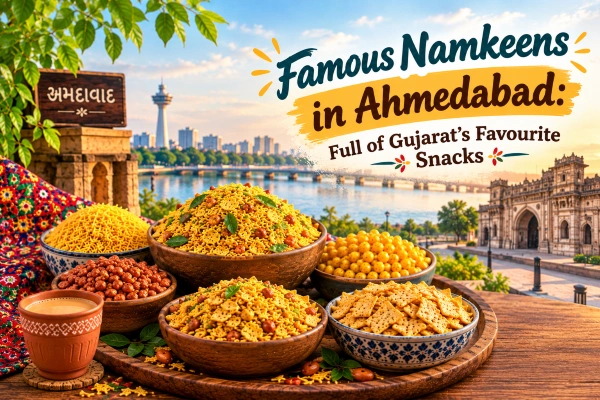
Ask anyone from Ahmedabad what makes a good evening, and “farsan-chai” will come up within the first two answers. Namkeen isn’t a side snack in this city — it’s practically a food group. Walk through any pol in the old city or any modern housing society in the west, and you’ll find steel dabbas of ganthiya, sev, and chevdo sitting on kitchen counters, refilled every week without fail.

Ahmedabad’s namkeen culture goes back generations, shaped by Gujarati vegetarian traditions, Jain dietary preferences, and a climate that made deep-fried, long-shelf-life snacks a practical everyday food. What started as homemade recipes passed down through families has grown into a thriving industry, with brands like KQB Food carrying forward authentic recipes while making them available to households across India.

In this guide, we’re covering the namkeens that have actually earned their fame in Ahmedabad — not generic snack-aisle names, but the ones locals specifically ask for by their full, proper names.

Ganthiya — The Undisputed King of Gujarati Namkeen

No namkeen list from Ahmedabad is complete without ganthiya, and no ganthiya conversation is complete without mentioning Bhavnagar. The Bhavnagari Ganthiya is thicker, softer, and more aromatic than regular sev-based ganthiya, made using a besan dough that’s been perfected over decades in Saurashtra. It’s the classic Sunday-morning-with-jalebi combination across Gujarat, but Ahmedabadis eat it any day of the week with a side of fried green chillies and a squeeze of lime.

For those who like a tangier, more textured version, the Athanu Bhavnagari Ganthiya brings pickle-style spicing into the mix, giving the ganthiya a distinctive achaari punch that pairs beautifully with a simple bowl of curd or chaas.

Sev — Ahmedabad’s Everyday Comfort Food

If ganthiya is the weekend indulgence, sev is the everyday workhorse of Gujarati namkeen. Ahmedabad kitchens rarely run without at least one variety of sev on hand — it goes into sev-tameta nu shaak, sev khamani, sev-puri, and of course, straight into the mouth as a mid-afternoon snack.

The classic Aloo Sev is a staple precisely because of its balance — the potato base gives it a lighter, softer bite than plain besan sev, and a mild spice level that works for both kids and adults. Move a notch spicier, and you get the Aloo Mari Sev, where black pepper (mari) cuts through the richness of the potato and besan, making it a favourite with tea-time regulars who want a bit more kick.

For something a little more adventurous, the Aloo Palakh Sev brings spinach into the dough, adding both colour and a subtle earthiness. It’s become popular in households looking for namkeen options that sneak in a bit of greens without compromising on taste — proof that Ahmedabad’s namkeen makers are innovating even within centuries-old formats.

Chevdo — Gujarat’s Answer to the Trail Mix

Every region of Gujarat has its own chevdo recipe, and Ahmedabad’s shelves are proof of that diversity. The Baroda No Lilo Chevdo — literally “the green chevdo of Baroda” — gets its signature colour and flavour from fresh green chillies and curry leaves mixed through flattened rice, peanuts, and lightly fried dals. It’s less about heat and more about a fresh, herby punch, which is exactly why it travels well beyond Vadodara and shows up in Ahmedabad’s own namkeen shops as a bestseller.

Chevdo works as a standalone snack, a topping for chaat, or the base of a quick breakfast mixed with curd — versatility that’s kept it relevant across generations of Gujarati households.

Bhakhri — The Snack That Doubles as a Meal

Technically a flatbread, bhakhri has firmly earned its place in the namkeen aisle in Ahmedabad because of how it’s eaten — dry, crisp, and straight from the packet, much like a cracker. It’s the namkeen equivalent of comfort food, often packed for train journeys and office lunches because it doesn’t need refrigeration and pairs with almost anything.

KQB Food’s bhakhri range covers the full spectrum of everyday flavours: the classic Bhakhri Sadi for those who prefer it plain and versatile, the aromatic Bhakhri Jeera with roasted cumin, the sharper Bhakhri Mari with black pepper, and the fragrant Bhakhri Methi made with fenugreek leaves. Each of these is also available in vacuum-packed formats — Sadi, Jeera, Mari, and Methi — for anyone who wants the crunch to last longer, whether that’s for travel, gifting, or simply stocking the pantry for the month.

Beyond the Basics: Moong and Patra

Ahmedabad’s namkeen shelf isn’t only about fried besan snacks. The Bhadran Moong — named after the town of Bhadran, known for its moong dal preparations — offers a lighter, protein-rich alternative that’s become a go-to for anyone trying to snack a little healthier without giving up on flavour.

For something entirely different, the Bardoli Na Dry Patra takes the classic colocasia-leaf patra — usually eaten fresh and steamed — and turns it into a dry, shelf-stable namkeen. It’s a great example of how Gujarati snack makers keep reinventing traditional dishes into formats that fit modern, busier lifestyles.

Why Ahmedabad’s Namkeen Culture Still Thrives

A big part of why these snacks have survived — and thrived — is consistency. Families in Ahmedabad are famously loyal to specific recipes and specific makers, often sticking to the same trusted source for ganthiya or sev for years. Brands like KQB Food have built their reputation on exactly this: keeping traditional recipes intact while making them accessible through online ordering, so that people who’ve moved out of Ahmedabad — or out of Gujarat entirely — can still get the same taste they grew up with.

You can browse the complete range on the KQB Food namkeen category page, which covers everything from the classics mentioned here to seasonal and regional specialities.

Ahmedabad’s namkeen scene is a living archive of Gujarat’s regional food history — Bhavnagar’s ganthiya, Baroda’s chevdo, Bhadran’s moong, and countless local variations of sev and bhakhri, all coexisting on the same snack shelf. Whether you’re a lifelong Ahmedabadi restocking your dabba or someone rediscovering these flavours after years away, these namkeens represent something that’s genuinely hard to replicate outside Gujarat. Explore the full range at KQB Food and bring a taste of authentic Ahmedabad home.

Frequently Asked Questions

1. What is the most famous namkeen from Ahmedabad? 

Ganthiya, especially Bhavnagari Ganthiya, is widely regarded as Ahmedabad and Gujarat’s most iconic namkeen, traditionally eaten with jalebi on Sunday mornings.

2. What’s the difference between sev and ganthiya? 

Sev is thinner and made by pressing besan dough through a fine sieve, while ganthiya is thicker, softer, and uses a slightly different dough consistency, giving it a chunkier bite.

3. Is chevdo the same as mixture or namkeen mix? 

Chevdo is a Gujarati-style mixture made primarily from flattened rice (poha), peanuts, and fried dals, seasoned with spices — it’s a regional variation of what’s broadly called “mixture” elsewhere in India.

4. Can bhakhri be eaten as a snack, not just a meal? 

Yes — dry bhakhri varieties like jeera, mari, and methi bhakhri are eaten as crisp, cracker-like snacks in Gujarati households, separate from soft bhakhri eaten with meals.

5. Are Gujarati namkeens like moong and patra healthier options? 

Moong-based namkeens are generally lighter and higher in protein compared to deep-fried besan snacks, while dry patra offers a vegetable-based alternative to typical fried namkeen.

6. Where can I buy authentic Ahmedabad namkeens online in India? 

You can order authentic, traditionally made namkeens including ganthiya, sev, chevdo, and bhakhri directly from KQB Food’s namkeen collection.

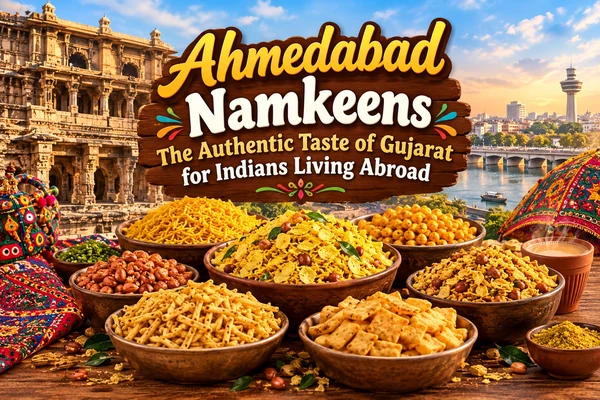
There’s a particular kind of homesickness that hits Gujaratis abroad, and it usually isn’t triggered by monuments or festivals — it’s triggered by the smell of freshly fried ganthiya, or the sound of a chevdo packet being opened at a family gathering. For the Indian diaspora, especially those who grew up in or have roots in Ahmedabad, namkeen isn’t just a snack category. It’s a direct line back to grandmother’s kitchen, Sunday breakfasts, and the pol lanes of the old city.

The good news is that authentic Ahmedabad namkeen no longer has to stay behind in India. Brands like KQB Food have made it possible for the Gujarati diaspora — across the US, UK, Canada, Australia, and the Gulf — to order the same traditional snacks their families back home have trusted for years, without compromising on recipe, texture, or spice authenticity.

This guide walks through the namkeens that define Ahmedabad’s food identity, and why they matter so much to Gujaratis living outside India.

Ganthiya: The Snack That Means “Home”

Ask any Gujarati abroad what they miss most from home, and ganthiya comes up almost immediately — not the mass-produced kind found in generic Indian grocery stores overseas, but the real, Bhavnagar-style version. The Bhavnagari Ganthiya is thicker and more textured than standard sev-based snacks, made from a besan dough recipe that’s been refined in Saurashtra for generations. For NRIs, ordering this specific variety — rather than settling for whatever “ganthiya” happens to be on a local shelf — makes a genuine difference in taste and nostalgia.

There’s also the Athanu Bhavnagari Ganthiya, which layers in pickle-style tang and spice. For anyone who grew up eating ganthiya alongside Gujarati athanu (pickle) at breakfast, this variety recreates that exact flavour combination in a single snack — something that’s genuinely hard to find outside India.

Sev Varieties: Everyday Snacking, Reimagined for Life Abroad

Sev is the snack most diaspora households reach for when they want something familiar but light — a quick tea-time bite, or a topping for improvised chaat when the “real” ingredients aren’t available locally. The Aloo Sev remains the most versatile, mild enough for kids born and raised abroad who are just being introduced to Gujarati flavours, while still tasting authentic to parents who grew up on it.

For those who want a bit more intensity — often the ones who’ve been away from India longest and crave stronger, spicier flavours as a reminder of home — the Aloo Mari Sev delivers a peppery kick that cuts through the richness of the besan and potato base. And for a modern twist that’s found favour even among second-generation Gujaratis who’ve grown up with more varied palates, the Aloo Palakh Sev blends spinach into the classic recipe, offering a snack that feels both nostalgic and current.

Chevdo: Gujarat’s Trail Mix, Ready for International Pantries

Chevdo travels exceptionally well, both literally and in terms of taste — it’s shelf-stable, doesn’t need refrigeration, and holds its crunch far longer than most other Indian snacks, which is exactly why it’s a favourite for international shipping. The Baroda No Lilo Chevdo, with its fresh green chilli and curry leaf flavour, is a standout for diaspora families who want something that tastes distinctly homemade rather than mass-manufactured. It works equally well as an everyday snack, a party mixer for gatherings with other Indian families abroad, or even a conversation-starting gift for non-Indian friends curious about Gujarati food.

Bhakhri: The Practical, Travel-Friendly Snack

For anyone who has ever tried to pack Indian food for a long-haul flight or a work lunch abroad, bhakhri is close to ideal — dry, crisp, and durable, without the mess or smell that other Indian snacks can carry. KQB Food’s bhakhri lineup includes the plain, everyday Bhakhri Sadi, the warmly spiced Bhakhri Jeera, the punchier Bhakhri Mari, and the fragrant Bhakhri Methi.

For international orders specifically, the vacuum-packed versions — Sadi, Jeera, Mari, and Methi bhakhri — are especially practical, since vacuum sealing helps preserve freshness and crunch over the longer transit times that come with shipping abroad.

Lighter and Lesser-Known Options Worth Trying

Not every classic Gujarati namkeen is deep-fried besan. The Bhadran Moong offers a lighter, protein-forward alternative that appeals to diaspora families balancing nostalgia with more health-conscious eating habits abroad. Meanwhile, the Bardoli Na Dry Patra turns the traditionally fresh, steamed colocasia-leaf patra into a dry, travel-friendly namkeen — a clever format for anyone who loved patra back home but can’t easily recreate it in a kitchen abroad.

Why Authenticity Matters More When You’re Far From Home

When you’re outside India, the margin for “close enough” narrows considerably. A namkeen that’s slightly off in spice balance, texture, or recipe doesn’t just taste different — it breaks the specific memory it’s supposed to trigger. This is where sourcing from a maker that sticks to traditional Gujarati recipes, like KQB Food, makes a real difference for the diaspora community. Every product in their namkeen range is made to the same standard that’s earned trust across Gujarat for years, not adapted or simplified for an international market.

For festivals, family gatherings, gifting fellow Gujaratis abroad, or simply restocking a pantry that’s run dry of anything familiar, having reliable access to these specific, correctly-made snacks is worth far more than convenience alone.

Conclusion

Namkeen from Ahmedabad carries a weight that’s hard to explain to anyone who didn’t grow up with it — it’s breakfast, festival food, travel snack, and comfort food all at once. For Gujaratis living abroad, being able to order the real Bhavnagari Ganthiya, authentic Baroda chevdo, or proper Bhadran moong isn’t a small convenience; it’s a way of staying connected to home. Explore the full collection at KQB Food and bring an authentic taste of Ahmedabad to wherever you’re living now.

Frequently Asked Questions

1. Can authentic Ahmedabad namkeen be shipped internationally?

Yes, brands like KQB Food cater to international orders, offering shelf-stable and vacuum-packed formats designed to stay fresh over longer shipping times.

2. Which Ahmedabad namkeen has the longest shelf life for international shipping?

Vacuum-packed bhakhri varieties and chevdo tend to travel best, as they’re naturally low-moisture and hold their crunch well over extended transit periods.

3. Why does homemade-style Gujarati namkeen taste different from what’s available abroad?

Many namkeens sold internationally are mass-produced with simplified recipes; brands that follow traditional Gujarati methods, like Bhavnagari-style ganthiya making, retain a noticeably more authentic texture and flavour.

4. Are there healthier Gujarati namkeen options for the diaspora?

Yes — options like Bhadran moong offer a lighter, protein-rich alternative to deep-fried besan snacks, suiting more health-conscious eating habits abroad.

5. What’s a good Gujarati namkeen to introduce to non-Indian friends?

Chevdo, particularly the milder, herby Baroda-style green chevdo, tends to be an approachable entry point since it’s less spicy and has a familiar trail-mix-like texture.

6. Where can NRIs order genuine Ahmedabad-style namkeen online?

The complete range of authentic Gujarati namkeens, including ganthiya, sev, chevdo, and bhakhri, is available through KQB Food’s official namkeen category.