

Freeze-Drying Is Older Than Most People Assume
Freeze-drying, technically known as lyophilisation, is often marketed as a modern convenience-food innovation, but the underlying principle has a documented history that predates refrigeration entirely. The Inca civilisation freeze-dried potatoes into a preserved food called chuño as early as the 13th century, using the natural freeze-thaw cycle of high-altitude Andean nights and days to remove moisture from the crop. The physics have not changed since; only the equipment used to control temperature and pressure has. What KQB Food applies to Gujarati and Jain home-cooked dishes today is the same core mechanism, engineered for consistency rather than left to weather.
Sublimation, Explained Without the Marketing Language
Freeze-drying works through a phase change called sublimation, where a substance moves directly from a solid to a gas without passing through a liquid state. In food preservation, this means the cooked dish is first frozen solid, then placed under reduced pressure so that the ice crystals within it convert directly to water vapour and are drawn off, rather than melting back into liquid water. Because the food never re-enters a liquid state during moisture removal, its original cell structure, shape, and much of its nutrient profile are preserved far more effectively than with heat-based dehydration, where evaporation under higher temperatures tends to degrade heat-sensitive vitamins and alter texture more aggressively.
This is the technical reason freeze-dried and carefully dehydrated meals can rehydrate back into something close to their original form when hot water is added, rather than turning into a mushy or unrecognisable version of the dish — the internal structure was never collapsed by melting in the first place.
Why This Matters Specifically for Indian Home-Cooked Food
Indian home meals — dals, sabzis, gravies, khichdi, and ras — are structurally more complex than the fruit and coffee applications most people associate with freeze-drying. A dal makhani, for instance, is a suspension of legumes, cream, and spice compounds, each of which behaves differently under moisture removal. Producing a freeze-dried or dehydrated version that rehydrates evenly, without one component turning gluey while another stays underdone, requires calibrating the process per dish rather than applying a single generic setting across an entire product line. According to KQB Food’s own process documentation, this preservation method is built to retain approximately 95% of a meal’s original nutrients, which is a meaningfully higher retention rate than most heavily processed, shelf-stable instant meal categories achieve.
From Kitchen to Sealed Packet: The Practical Process
• The dish is cooked fully first, using the same traditional method and ratios as a home-cooked version, not a reformulated “shelf-stable recipe.”
• Moisture is removed via dehydration or freeze-drying (sublimation), depending on the dish, to reach a stable, shelf-safe state without heavy preservatives.
• The dried product is portioned and sealed under controlled, hygienic conditions to lock in freshness and prevent moisture re-entry.
• Rehydration at the consumer end typically involves adding hot or boiling water and allowing the dish a short resting period before serving.
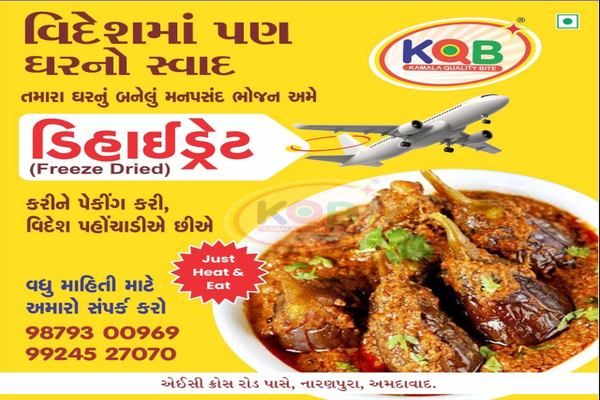
For customers who want an existing home-cooked dish preserved this way rather than choosing from our packaged catalogue, KQB Food also offers a dedicated Dehydrated Food Packaging Service, where your own recipe or a family dish can be processed and vacuum-sealed for travel or long-distance shipping — a detail explained further in the international dehydrated food packaging guide on this site.
Who This Actually Serves
Freeze-dried and dehydrated Indian meals solve a specific, recurring problem for a specific set of people: students relocating abroad for the first time who cannot yet cook confidently for themselves; frequent international travellers who want a reliable vegetarian or Jain meal option regardless of destination; people managing dietary restrictions such as diabetes or food allergies who need predictable, controlled ingredients; and anyone who simply wants the option of a genuinely home-style meal on a day when cooking is not realistic. None of these use cases are served well by conventional instant noodles or canned food, which is the actual gap this category fills.
Frequently Asked Questions
1. What is the actual difference between freeze-drying and regular dehydration?
Regular dehydration removes moisture using heat and airflow, causing the food to pass through a liquid state as it dries. Freeze-drying removes moisture through sublimation, converting ice directly to vapour without a liquid phase, which better preserves structure and nutrients.
2. How long does freeze-dried or dehydrated Indian food actually last?
Properly sealed dehydrated and freeze-dried meals are designed for a long ambient shelf life without refrigeration, making them practical for international shipping and extended travel.
3. Does freeze-dried food taste noticeably different from the fresh dish?
Because the process avoids melting the food’s internal ice structure, rehydrated freeze-dried meals generally retain a texture and flavour closer to the original dish than heat-dehydrated alternatives.
4. Can I get my own family recipe freeze-dried or dehydrated for travel?
Yes, KQB Food offers a dedicated dehydrated food packaging service for custom, home-cooked meals in addition to its ready-made packaged range.
Explore Freeze-Dried and Dehydrated Indian Meals
See the full Dehydrated Food (Freezed-Dried Food) catalogue, the SECO Delights range, and our Dehydrated Food Packaging Service at kqbfood.com. Find us on Google: KQB Food, Naranpura, Ahmedabad.