

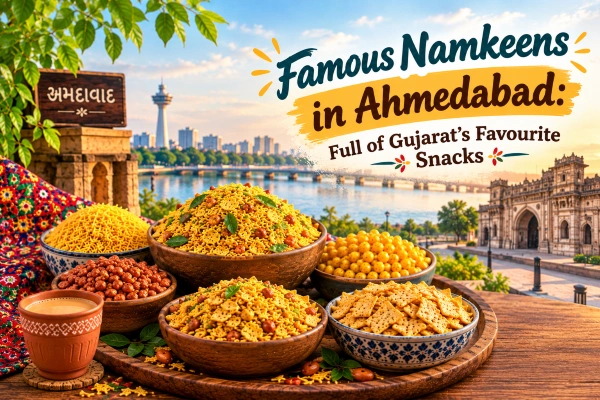
Ask anyone from Ahmedabad what makes a good evening, and “farsan-chai” will come up within the first two answers. Namkeen isn’t a side snack in this city — it’s practically a food group. Walk through any pol in the old city or any modern housing society in the west, and you’ll find steel dabbas of ganthiya, sev, and chevdo sitting on kitchen counters, refilled every week without fail.
Ahmedabad’s namkeen culture goes back generations, shaped by Gujarati vegetarian traditions, Jain dietary preferences, and a climate that made deep-fried, long-shelf-life snacks a practical everyday food. What started as homemade recipes passed down through families has grown into a thriving industry, with brands like KQB Food carrying forward authentic recipes while making them available to households across India.
In this guide, we’re covering the namkeens that have actually earned their fame in Ahmedabad — not generic snack-aisle names, but the ones locals specifically ask for by their full, proper names.
Ganthiya — The Undisputed King of Gujarati Namkeen
No namkeen list from Ahmedabad is complete without ganthiya, and no ganthiya conversation is complete without mentioning Bhavnagar. The Bhavnagari Ganthiya is thicker, softer, and more aromatic than regular sev-based ganthiya, made using a besan dough that’s been perfected over decades in Saurashtra. It’s the classic Sunday-morning-with-jalebi combination across Gujarat, but Ahmedabadis eat it any day of the week with a side of fried green chillies and a squeeze of lime.
For those who like a tangier, more textured version, the Athanu Bhavnagari Ganthiya brings pickle-style spicing into the mix, giving the ganthiya a distinctive achaari punch that pairs beautifully with a simple bowl of curd or chaas.
Sev — Ahmedabad’s Everyday Comfort Food
If ganthiya is the weekend indulgence, sev is the everyday workhorse of Gujarati namkeen. Ahmedabad kitchens rarely run without at least one variety of sev on hand — it goes into sev-tameta nu shaak, sev khamani, sev-puri, and of course, straight into the mouth as a mid-afternoon snack.
The classic Aloo Sev is a staple precisely because of its balance — the potato base gives it a lighter, softer bite than plain besan sev, and a mild spice level that works for both kids and adults. Move a notch spicier, and you get the Aloo Mari Sev, where black pepper (mari) cuts through the richness of the potato and besan, making it a favourite with tea-time regulars who want a bit more kick.
For something a little more adventurous, the Aloo Palakh Sev brings spinach into the dough, adding both colour and a subtle earthiness. It’s become popular in households looking for namkeen options that sneak in a bit of greens without compromising on taste — proof that Ahmedabad’s namkeen makers are innovating even within centuries-old formats.
Chevdo — Gujarat’s Answer to the Trail Mix
Every region of Gujarat has its own chevdo recipe, and Ahmedabad’s shelves are proof of that diversity. The Baroda No Lilo Chevdo — literally “the green chevdo of Baroda” — gets its signature colour and flavour from fresh green chillies and curry leaves mixed through flattened rice, peanuts, and lightly fried dals. It’s less about heat and more about a fresh, herby punch, which is exactly why it travels well beyond Vadodara and shows up in Ahmedabad’s own namkeen shops as a bestseller.
Chevdo works as a standalone snack, a topping for chaat, or the base of a quick breakfast mixed with curd — versatility that’s kept it relevant across generations of Gujarati households.
Bhakhri — The Snack That Doubles as a Meal
Technically a flatbread, bhakhri has firmly earned its place in the namkeen aisle in Ahmedabad because of how it’s eaten — dry, crisp, and straight from the packet, much like a cracker. It’s the namkeen equivalent of comfort food, often packed for train journeys and office lunches because it doesn’t need refrigeration and pairs with almost anything.
KQB Food’s bhakhri range covers the full spectrum of everyday flavours: the classic Bhakhri Sadi for those who prefer it plain and versatile, the aromatic Bhakhri Jeera with roasted cumin, the sharper Bhakhri Mari with black pepper, and the fragrant Bhakhri Methi made with fenugreek leaves. Each of these is also available in vacuum-packed formats — Sadi, Jeera, Mari, and Methi — for anyone who wants the crunch to last longer, whether that’s for travel, gifting, or simply stocking the pantry for the month.
Beyond the Basics: Moong and Patra
Ahmedabad’s namkeen shelf isn’t only about fried besan snacks. The Bhadran Moong — named after the town of Bhadran, known for its moong dal preparations — offers a lighter, protein-rich alternative that’s become a go-to for anyone trying to snack a little healthier without giving up on flavour.
For something entirely different, the Bardoli Na Dry Patra takes the classic colocasia-leaf patra — usually eaten fresh and steamed — and turns it into a dry, shelf-stable namkeen. It’s a great example of how Gujarati snack makers keep reinventing traditional dishes into formats that fit modern, busier lifestyles.
Why Ahmedabad’s Namkeen Culture Still Thrives
A big part of why these snacks have survived — and thrived — is consistency. Families in Ahmedabad are famously loyal to specific recipes and specific makers, often sticking to the same trusted source for ganthiya or sev for years. Brands like KQB Food have built their reputation on exactly this: keeping traditional recipes intact while making them accessible through online ordering, so that people who’ve moved out of Ahmedabad — or out of Gujarat entirely — can still get the same taste they grew up with.
You can browse the complete range on the KQB Food namkeen category page, which covers everything from the classics mentioned here to seasonal and regional specialities.
Ahmedabad’s namkeen scene is a living archive of Gujarat’s regional food history — Bhavnagar’s ganthiya, Baroda’s chevdo, Bhadran’s moong, and countless local variations of sev and bhakhri, all coexisting on the same snack shelf. Whether you’re a lifelong Ahmedabadi restocking your dabba or someone rediscovering these flavours after years away, these namkeens represent something that’s genuinely hard to replicate outside Gujarat. Explore the full range at KQB Food and bring a taste of authentic Ahmedabad home.
Frequently Asked Questions
1. What is the most famous namkeen from Ahmedabad?
Ganthiya, especially Bhavnagari Ganthiya, is widely regarded as Ahmedabad and Gujarat’s most iconic namkeen, traditionally eaten with jalebi on Sunday mornings.
2. What’s the difference between sev and ganthiya?
Sev is thinner and made by pressing besan dough through a fine sieve, while ganthiya is thicker, softer, and uses a slightly different dough consistency, giving it a chunkier bite.
3. Is chevdo the same as mixture or namkeen mix?
Chevdo is a Gujarati-style mixture made primarily from flattened rice (poha), peanuts, and fried dals, seasoned with spices — it’s a regional variation of what’s broadly called “mixture” elsewhere in India.
4. Can bhakhri be eaten as a snack, not just a meal?
Yes — dry bhakhri varieties like jeera, mari, and methi bhakhri are eaten as crisp, cracker-like snacks in Gujarati households, separate from soft bhakhri eaten with meals.
5. Are Gujarati namkeens like moong and patra healthier options?
Moong-based namkeens are generally lighter and higher in protein compared to deep-fried besan snacks, while dry patra offers a vegetable-based alternative to typical fried namkeen.
6. Where can I buy authentic Ahmedabad namkeens online in India?
You can order authentic, traditionally made namkeens including ganthiya, sev, chevdo, and bhakhri directly from KQB Food’s namkeen collection.