

Why “Gluten-Free” and “Diet” Are Not the Same Claim
For international shoppers researching Indian snacks, the terms gluten-free and diet-friendly are frequently used interchangeably, but they describe different formulations and serve different needs. Gluten-free khakhra is built around the exclusion of wheat, barley, and rye-derived flours, replacing them with grains such as ragi (finger millet), bajra (pearl millet), or jowar (sorghum) — a requirement for anyone with coeliac disease or a diagnosed gluten intolerance. Diet khakhra, by contrast, is generally about calorie and oil density: it can still contain wheat, but is roasted with less oil and portioned for lighter snacking. Understanding this distinction before ordering saves both money and disappointment, especially when shipping internationally means a longer wait for a replacement order.
The Grain Science Behind Millet-Based Khakhra
Ragi and bajra are both classified as “nutri-cereals” in Indian agricultural policy because of their micronutrient density relative to refined wheat. Ragi is notable for its calcium content and a comparatively low glycaemic response, which is why it appears frequently in diabetic-friendly meal planning across South Asia. Bajra, meanwhile, is higher in iron and fibre and has a coarser, nuttier bite that changes the texture of khakhra noticeably compared to a wheat base — it roasts to a denser crunch rather than a light, flaky snap.
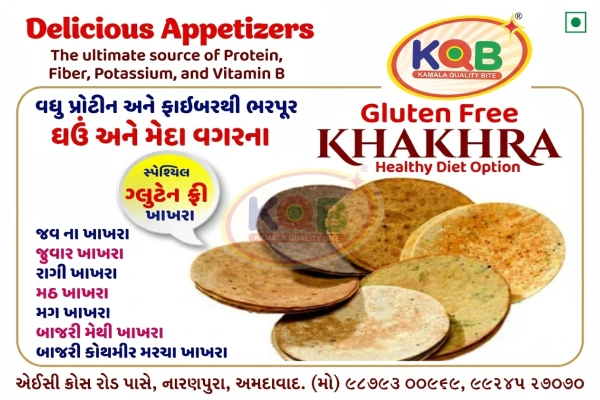
When these grains are used for khakhra, the dough hydration and rolling technique both need adjustment, because millet flours lack the gluten network that gives wheat dough its elasticity. This is precisely why gluten-free khakhra production is a distinct process rather than a simple ingredient swap, and why quality varies significantly between brands. Our Gluten-Free Khakhra range and broader Variety Khakhra catalogue include bajra and bajra-methi formulations built specifically to hold together and roast evenly despite the absence of gluten.
Roasted, Not Fried: The Underlying Reason Khakhra Reads as a “Diet” Snack
Khakhra’s reputation as a lighter snack option comes down to preparation method rather than ingredients alone. Unlike many deep-fried Indian namkeen, khakhra is roasted directly on a tawa (griddle) in thin, pressed layers, which significantly reduces the oil absorbed during cooking compared to frying. This roasting method is also what gives khakhra its long, ambient shelf life without heavy preservative use, which matters for anyone ordering it for international shipping where transit can take days to weeks.
What International Buyers Should Check Before Ordering
• Confirm whether the product is labeled strictly gluten-free (millet-based) or simply “lighter” wheat khakhra, since only the former is safe for coeliac diets.
• Check ingredient lists for cross-contact disclosures if you have a severe gluten allergy rather than a general sensitivity.
• Factor in shipping duration to your country when choosing between smaller trial packs and bulk orders.
• Pair millet-based khakhra with our Diet Namkeen range if you want a fully lower-oil snack box rather than mixing in regular fried namkeen.
Why Sourcing From an Established Ahmedabad Maker Matters Internationally
Gluten-free and diet khakhra are more sensitive to manufacturing inconsistency than regular wheat khakhra, because millet doughs are harder to work with and easier to under- or over-roast. KQB Food has been producing traditional Gujarati snacks since 2005, as outlined on our About Us page, and our production base in Naranpura, Ahmedabad follows the same recipes used for decades in Gujarati households, adapted for millet flours rather than reformulated from scratch for a health-food market. For a diaspora buyer, that lineage matters: it is the difference between a snack engineered for a nutrition label and one that still tastes like the khakhra you grew up with.
Frequently Asked Questions
1. Is all khakhra automatically gluten-free?
No. Most traditional khakhra is made from wheat flour and is not gluten-free. Only khakhra explicitly made from ragi, bajra, jowar, or other non-wheat flours qualifies as gluten-free.
2. Is diet khakhra suitable for someone with coeliac disease?
Not necessarily. “Diet” typically refers to reduced oil and calorie content, not the absence of gluten. Coeliac buyers should specifically choose gluten-free (millet-based) khakhra.
3. Does gluten-free khakhra taste different from wheat khakhra?
Yes. Millet-based khakhra, particularly bajra, has a denser, nuttier texture compared to the light, flaky crunch of wheat khakhra.
4. Can gluten-free and diet khakhra be shipped internationally?
Yes, khakhra is roasted rather than fried and has a naturally long ambient shelf life, which makes it practical to ship to international addresses, subject to each country’s food import regulations.
Explore Our Gluten-Free and Diet Khakhra Range
Browse Gluten-Free Khakhra and Diet Khakhra Online at kqbfood.com, or see our full Buy Khakhra Online catalogue. Find our Ahmedabad facility on Google: KQB Food, Naranpura.