

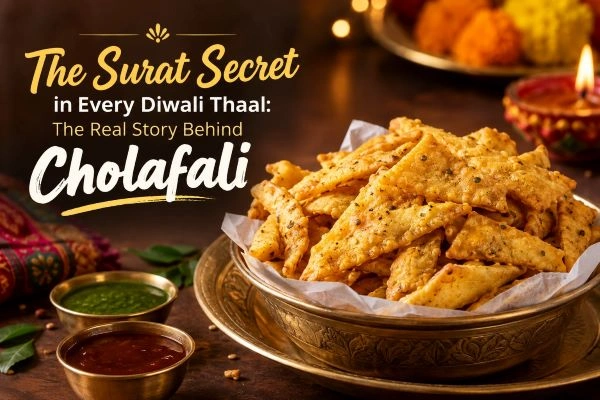
Most people who eat cholafali every Diwali have never actually asked where it came from — it just appears on the farsan thaal, gets devoured in minutes, and shows up again the following year like clockwork. But cholafali has a specific, traceable origin story, and understanding it explains a lot about why this particular snack became a festival fixture rather than just another item in Gujarat’s enormous namkeen catalogue.
With Diwali 2026 arriving on Sunday, November 8, and the festivities running from Dhanteras on November 6 through Bhai Dooj on November 10, this is a good moment to look at cholafali not just as something to order, but as a snack with a genuine craft behind it — one that’s worth understanding before it lands on your farsan plate this year.
Where Cholafali Actually Comes From
Cholafali is widely credited to Surat, a city that has historically punched above its weight when it comes to Gujarati food innovation — the same city that gave Gujarat locho, ghari, and undhiyu as we know it today. Surti cooks are known for taking relatively simple ingredients and applying an almost obsessive level of technique to them, and cholafali is a textbook example of that approach.
Unlike ganthiya or sev, which rely mainly on the right spice mix and frying temperature, cholafali depends heavily on how thin the dough sheets are rolled before frying. Traditionally, skilled cholafali makers in Surat could roll the urad-moong dal dough thin enough that it would puff up into an almost transparent, glass-like sheet the moment it hit hot oil — a skill that took years to master and is still considered a mark of quality today. This is why authentic cholafali has such a distinct, delicate texture compared to other fried Gujarati snacks; it’s essentially a technique-driven food, not just a recipe-driven one.
How Cholafali Travelled From Surat to Every Gujarati Home
As Gujarati families moved between cities — Surat to Ahmedabad, Ahmedabad to Vadodara, and eventually across India and abroad — cholafali travelled with them, carried both as a physical gift and as a recipe passed down through households. Over time, it stopped being a “Surti specialty” and became a pan-Gujarati festival staple, particularly for Diwali, when families wanted something that felt a little more special than everyday farsan.
What helped cement its place at Diwali specifically is practical: cholafali doesn’t get made casually on a random Tuesday. Because of the skill and time the thin-rolling technique demands, it has historically been reserved for occasions worth the effort — weddings, Diwali, and other major family gatherings. That association has stuck, which is why cholafali still feels like an “occasion snack” even now, when most Gujarati households buy it ready-made rather than rolling it by hand.
The Flavour That Makes Cholafali Different
What separates cholafali from nearly every other item on a Diwali farsan plate is its layered taste. The base is savoury and mildly earthy from the urad and moong dal, but it’s finished with black salt, coarsely ground black pepper, and a light sugar-lime syrup brushed across the surface — giving it a sweet-tangy-spicy hit that changes with every bite, depending on which part of the sheet you’re eating.
This is a deliberate contrast to the rest of a typical Gujarati Diwali spread, which tends to lean heavily savoury (ganthiya, sev, mathiya) or heavily sweet (mithai). Cholafali sits in between, which is exactly why it doesn’t get skipped even when the plate is already full — it offers something the rest of the thaal doesn’t.
Two Ways to Experience Cholafali This Diwali
KQB Food keeps this traditional Surat-style preparation intact across its cholafali range, giving you two ways to experience the snack depending on preference. The Cholafali follows the classic thin-rolled, lightly fried style — the version closest to what you’d find at an old-school Surat farsan shop, with that signature delicate crunch and balanced sweet-spice finish.
For those who prefer a heartier bite, the Fried Cholafali takes the same base preparation through a deeper fry, resulting in a firmer, more robust crunch that holds up especially well in Diwali gift boxes and during the five days of guest visits when a container might be opened and closed repeatedly.
Why This Origin Story Matters When You’re Buying Cholafali
Knowing where cholafali comes from is more than trivia — it’s actually a useful way to judge quality. Because the entire identity of cholafali rests on how thin and evenly it’s rolled before frying, poorly made versions tend to be thicker, chewier, or unevenly puffed, losing the glass-like crispness that defines the real thing. When you’re ordering online, especially ahead of a busy festival like Diwali, sourcing from a maker that respects that original Surat technique — rather than a generic, mass-produced version — makes a noticeable difference in the final bite.
This is where KQB Food has built its reputation within Gujarat’s namkeen space: sticking to traditional preparation methods across its farsan range rather than cutting corners for scale. You can explore the full selection on the Cholafali category page, or browse the wider Papad/Mathiya section to round out your Diwali farsan order.
Cholafali’s journey from a Surat specialty to a Diwali essential across Gujarat is really a story about craft outlasting convenience — a snack that stuck around specifically because it was harder to make well, not easier. As Diwali 2026 approaches on November 8, that history is worth remembering the next time a plate of cholafali gets passed around your Diwali gathering. Order the authentic version, in both classic and fried styles, from KQB Food and bring a genuine piece of Surti craftsmanship to this year’s farsan thaal.
Frequently Asked Questions
1. Which city is cholafali originally from?
Cholafali is widely credited to Surat, a city known for its intricate, technique-heavy approach to Gujarati snacks and sweets.
2. Why is cholafali associated with special occasions rather than everyday snacking?
Its preparation requires skillfully rolling the dough into extremely thin sheets before frying, a time-consuming technique traditionally reserved for weddings, Diwali, and other major celebrations.
3. What gives cholafali its distinctive taste?
Cholafali is finished with black salt, black pepper, and a light sugar-lime syrup, creating a sweet-tangy-spicy flavour that’s different from most other Gujarati namkeens.
4. How can I tell if cholafali is made using traditional technique?
Authentic, well-made cholafali is very thin, evenly puffed, and almost glass-like in texture; thicker or unevenly fried versions usually indicate a shortcut in preparation.
5. What’s the difference between regular and fried cholafali?
Regular cholafali has the classic thin, delicate crunch, while fried cholafali goes through a deeper fry for a firmer, heartier bite and slightly sturdier shelf life.
6. Where can I buy authentic, Surat-style cholafali online for Diwali 2026?
You can order both classic and fried cholafali directly from KQB Food’s Cholafali collection.